


Running a small business is a bit like juggling flaming torches while riding a unicycle. You’re handling sales, customer service, payroll, and somehow you’re also supposed to be an SEO expert? No wonder so many small business owners feel stuck when it comes to getting found on Google.
- Why Small Businesses Can’t Afford to Ignore SEO Anymore
- Quick Comparison
- What Actually Matters in SEO Software for Small Business
- Best Keyword Research Tools
- Best Rank Tracking Tools
- Best Tools for Competitor Analysis
- Best SEO Audit Tools
- Local SEO Tools and Why They Deserve Their Own Budget Line
- AI SEO Tools Worth Watching in 2026
- How Much Should Small Businesses Spend on SEO Tools?
- How to Choose the Right SEO Tools for Your Small Business
- Common Mistakes to Avoid When Buying SEO Software
- Final Thoughts
- Frequently Asked Questions
Here’s the good news. You don’t need to become an SEO expert overnight. You just need the right tools doing the heavy lifting for you.
In this guide, we’ll walk through the best SEO tools for small business owners in 2026, covering keyword research, rank tracking, competitor analysis, SEO audits, and the newer wave of AI SEO tools. Along the way, we’ll drop in a few “did you know” stats that explain why this stuff actually matters, not just for ranking bragging rights, but for real revenue. By the end, you’ll know exactly which tools fit your budget and which ones you can skip for now.


Why Small Businesses Can’t Afford to Ignore SEO Anymore
Let’s start with a number that tends to stop people mid-scroll.
Did you know? 68% of all online experiences begin with a search engine, according to BrightEdge and Forrester data compiled by Search Atlas. That means more than two out of every three potential customers are starting their journey to your business on Google, not your Instagram feed or your email list.
That single stat explains why SEO software has become such a crowded market. Search is still the front door to almost every purchase decision, whether someone ends up buying online or walking into your store.
Here’s another one worth sitting with:
Did you know? Organic search drives roughly 53% of all trackable website traffic, and SEO generates more than 1,000% more traffic than organic social media, according to BrightEdge.
In other words, that carefully crafted Instagram caption is working hard, but it’s probably not doing nearly as much for your bottom line as a well-optimized page that ranks for what your customers are actually searching.
Yet despite knowing all this, most small businesses still hesitate. Research from the Small Business Expo Research Desk found that 63.6% of small businesses consider appearing in Google search results very important or critical to their success, but a large share still don’t have a consistent SEO strategy in place. Therefore, there’s a real gap between knowing SEO matters and actually doing something about it. That gap is exactly where the right tools come in.
Quick Comparison
| Tool | Best For | Starting Price* | Free Option |
|---|---|---|---|
| Google Search Console + GA4 | Baseline tracking every business needs | Free | Yes |
| Semrush | All-in-one SEO software | ~$140/mo | Limited trial |
| Ahrefs | Backlinks and competitor research | ~$29/mo (Starter) | No full free trial |
| SE Ranking | Best value all-in-one suite | ~$129/mo | 14-day trial |
| Mangools | Simple, beginner-friendly | ~$29 to $37/mo | Limited free account |
| Surfer SEO | Content optimization | ~$119/mo | Free tier |
| Screaming Frog | Technical SEO audits | Free (up to 500 URLs) | Yes |
*Pricing shifts often, so double-check current rates before you commit. We compare two of the biggest names, Semrush vs Ahrefs, in a separate deep dive if you want to go further down that particular rabbit hole.
What Actually Matters in SEO Software for Small Business
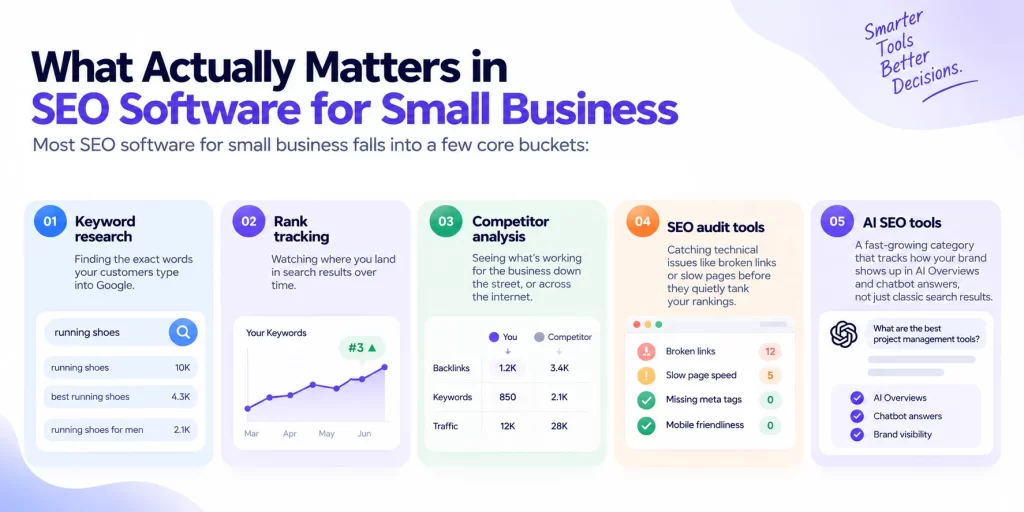
Before you swipe your card, it helps to know what you’re actually paying for. Most SEO software for small business falls into a few core buckets:
- Keyword research: finding the exact words your customers type into Google
- Rank tracking: watching where you land in search results over time
- Competitor analysis: seeing what’s working for the business down the street, or across the internet
- SEO audit tools: catching technical issues like broken links or slow pages before they quietly tank your rankings
- AI SEO tools: a fast-growing category that tracks how your brand shows up in AI Overviews and chatbot answers, not just classic search results
Here’s the thing though. You don’t need every feature in a $500 a month enterprise suite. That would be like buying a commercial oven to make toast. Most small businesses do just fine with software that covers their specific gaps, nothing more.
It also helps to understand what you’re competing against. Google alone processes over 8.5 billion searches every single day. That’s an enormous amount of demand, but also an enormous amount of competition for attention. The right tools help you find the specific slice of that demand you can realistically win.
Best Keyword Research Tools
- Google Search Console (Free). This is your non-negotiable starting point, and it costs nothing. It shows the exact queries already bringing visitors to your site, along with click-through rates and any indexing issues you need to fix.
- Mangools (KWFinder). Widely considered one of the most beginner-friendly keyword research tools on the market, with a clean interface and difficulty scores people actually trust. Its Basic plan runs about $29 a month on annual billing, roughly a fifth of what you’d pay to get started with Ahrefs.
- Semrush and Ahrefs. Both offer deep keyword databases, clustering tools, and long-tail keyword suggestions. However, they come with steeper prices and a longer learning curve than Mangools.
- Ubersuggest. A budget-friendly pick from Neil Patel’s team that bundles keyword suggestions with basic site audits, making it a reasonable low-cost entry point for solo business owners.
Here’s a stat that changes how a lot of business owners think about keyword research:
Did you know? An estimated 95% of the entire keyword database receives fewer than 10 searches a month. That sounds discouraging until you realize it’s actually good news for small businesses. You don’t need to outrank giant brands for massive, competitive terms. You need to own a long list of smaller, specific searches that add up to real traffic, and often convert better because they’re more specific to what the searcher actually wants.
That’s the whole logic behind long-tail keyword strategy, and it’s exactly what a good keyword research tool helps you uncover.
Best Rank Tracking Tools
If you run a local business, rank tracking deserves extra attention. Local, location-based tracking often matters more than a massive keyword database.
- SE Ranking covers keyword research, rank tracking, backlink analysis, and site audits starting around $52 a month on annual billing. Its rank tracker updates daily and supports local search tracking in more than 100 countries, which is a genuine win for local service businesses.
- Semrush Position Tracking is detailed and reliable, but it’s bundled inside pricier plans starting around $140 a month.
- Ahrefs Rank Tracker delivers strong data quality as part of plans that now start around $29 a month for the newer Starter tier, scaling up from there.
Why does rank tracking matter so much? Consider this: 46% of all Google searches have local intent, meaning nearly half of all searches involve someone looking for something nearby. If you’re not tracking where you rank for those local terms, you have no way of knowing whether you’re capturing that demand or handing it straight to a competitor.
Best Tools for Competitor Analysis
Ever wonder why a competitor outranks you despite having a worse-looking website? Competitor analysis tools are how you find out.
- Ahrefs remains the benchmark here. Its backlink index is widely seen as one of the industry’s most reliable, so you can see exactly who links to your competitors and why. One catch: Ahrefs no longer offers a full free trial, so you’re committing before you can properly test the full product.
- Semrush covers similar ground with tools built to uncover rivals’ strategies, plus a local SEO toolkit for region-specific businesses, all inside its broader all-in-one suite.
- SpyFu, starting around $39 a month, is worth a look if competitor ad strategy matters as much as organic search to you.
Competitor analysis isn’t about copying what other businesses do. It’s more like studying game film. You’re looking for patterns: which keywords are working for them, which pages get the most links, and where the gaps are that you could fill better than they have.
Best SEO Audit Tools
- Screaming Frog is the standard for technical crawls. It offers unlimited crawls for websites up to 500 URLs for free, which covers plenty of local businesses, service providers, and small e-commerce sites without spending a dime. Paid plans remove the URL cap entirely.
- Google Search Console flags indexing errors, mobile usability problems, and Core Web Vitals issues at no cost, making it a natural companion to Screaming Frog.
- Moz Pro, priced around $49 to $99 a month, is known for its domain authority metric and audit reports that are easy for beginners to digest.
Technical issues are sneaky because they don’t announce themselves. Your site doesn’t send you a text message when a page starts loading slowly. It just quietly loses rankings while you’re busy running the actual business. That’s exactly why a periodic audit, even just once a quarter, is worth the small time investment.
Local SEO Tools and Why They Deserve Their Own Budget Line
If your business serves a specific city or region, local SEO deserves a category of its own, separate from general SEO software. The numbers here are hard to ignore.
Did you know? According to Think with Google data, 76% of people who search for something local visit a business within 24 hours, and roughly 28% of those local searches lead directly to a purchase.
That’s an enormous conversion window, and it’s exactly why tools with strong local search and Google Business Profile features earn their keep.
A few things worth knowing about local search performance in 2026:
- Consumers overwhelmingly trust online reviews, with the vast majority of shoppers reading reviews before choosing a local business
- Businesses that appear in the local 3-pack (the top map results) receive dramatically more clicks and calls than those ranked further down
- Crossing the 50-review threshold on Google Business Profile is consistently cited as one of the highest-leverage moves a local business can make
None of this requires expensive software. Google Business Profile itself is free, and tools like SE Ranking and Semrush both include local rank tracking as part of their broader plans. In contrast, some businesses waste money on standalone local SEO tools when a feature already bundled into their existing subscription would have done the job.
AI SEO Tools Worth Watching in 2026
The biggest shift in SEO software this year isn’t a flashy new keyword tool. It’s visibility tracking for AI-generated answers.
Tracking brand mentions in ChatGPT, Gemini, Perplexity, and Google AI Overviews is increasingly treated as seriously as classic rank tracking, and for good reason. (If you use ChatGPT Go on the free India plan yourself, see what to do when the ChatGPT Go free year ends.)
Did you know? Some industry analyses show organic click-through rates for the number one Google result dropping from around 28% to 19% between 2024 and 2025, largely driven by the growth of AI Overviews and zero-click search results.
That’s a meaningful shift. It means ranking first doesn’t guarantee the same volume of clicks it used to, because more searchers are getting their answer directly on the results page, or from an AI chatbot, without ever visiting a website.
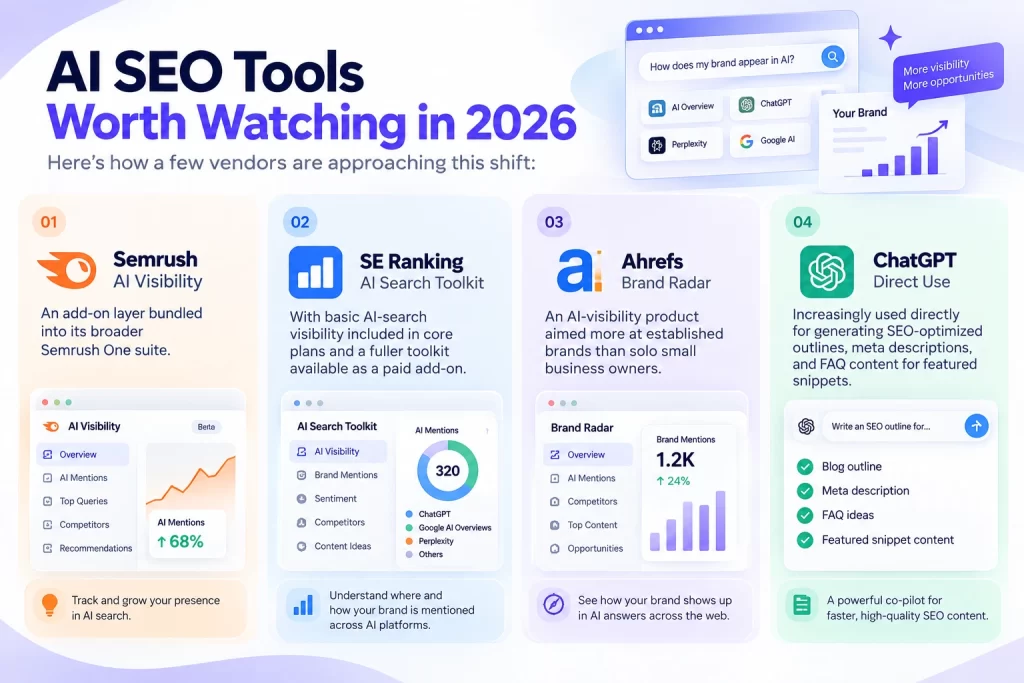
Here’s how a few vendors are approaching this shift:
- Semrush AI Visibility, an add-on layer bundled into its broader Semrush One suite
- SE Ranking’s AI Search Toolkit, with basic AI-search visibility included in core plans and a fuller toolkit available as a paid add-on
- Ahrefs Brand Radar, an AI-visibility product aimed more at established brands than solo small business owners
- ChatGPT itself, increasingly used directly for generating SEO-optimized outlines, meta descriptions, and FAQ content for featured snippets
There’s also a workforce angle worth mentioning. Semrush’s own research suggests that around 67% of small business owners and marketers already use AI tools somewhere in their content marketing and SEO workflow. In short, AI isn’t a future trend for small business SEO. It’s already part of the daily toolkit for most of your competitors.
For most small businesses, dedicated AI visibility tracking is still a “watch and budget for later” category rather than a day-one must-have. The fundamentals, keyword research, technical health, and rank tracking, still drive the majority of results.
How Much Should Small Businesses Spend on SEO Tools?
This is one of the most common questions we hear, and the honest answer is: it depends heavily on whether you’re doing SEO yourself or hiring it out.
For software alone, most small businesses can get meaningful value from a $30 to $150 a month budget, covering one core keyword and rank tracking tool plus occasional use of a free audit tool like Screaming Frog.
For broader SEO spending, including agencies or freelancers, the range widens considerably. According to Ahrefs, SEO pricing typically falls between $250 and $10,000 a month, with roughly 63% of businesses investing between $500 and $5,000 monthly. That’s a wide range, and it should be. A solo consultant optimizing a five-page website needs a very different budget than a multi-location business competing in a crowded market.
A reasonable rule of thumb: start with free tools, add one paid tool once you have a clear gap it solves, and only bring in outside help once you’ve validated that SEO is actually moving the needle for your specific business.
How to Choose the Right SEO Tools for Your Small Business
- Just starting out, tight budget: Google Search Console and GA4 (free), plus Mangools or Ubersuggest
- Growing business, want one tool that does it all: Semrush or SE Ranking
- Backlinks and competitor intel are your top priority: Ahrefs
- Content-heavy site, want on-page optimization: Surfer SEO
- Mostly worried about technical issues: Screaming Frog paired with Search Console
- Serving a local area: prioritize whichever tool has the strongest local rank tracking and Google Business Profile integration
Most small businesses end up with a stack of two or three tools rather than one giant platform: a free baseline, one paid research or tracking tool, and a technical audit tool used periodically rather than every single month.
Common Mistakes to Avoid When Buying SEO Software
A few missteps show up again and again with small business owners shopping for SEO tools:
- Buying enterprise features you’ll never use. If you’re a one-location business, you probably don’t need a tool built for managing hundreds of client accounts.
- Skipping the free trial. Most paid tools offer a trial or a limited free tier. Test the actual workflow before committing to an annual plan.
- Ignoring local SEO features. If half your customers find you through “near me” searches, a tool without solid local tracking is missing the point entirely.
- Treating software as a substitute for strategy. A tool tells you what’s happening. It doesn’t write your content, fix your site structure, or decide which keywords matter most to your business. That part still takes a human.
- Forgetting to revisit the decision. The tool that fit your business at 5 employees might not fit at 50. Revisit your stack once a year.
Final Thoughts
Choosing the best SEO tools for small business isn’t about grabbing the shiniest, most expensive option on the shelf. It’s about matching software to the gaps you actually have, whether that’s keyword research, rank tracking, competitor analysis, or technical audits.
The stats bear this out again and again. Search is still where the vast majority of buying journeys begin, local search converts at a remarkably high rate, and AI is already reshaping how results get discovered. Ignoring any of that isn’t really an option anymore, even for the smallest of businesses.
Start small, prove the value, then expand your toolkit as your traffic and budget grow. Therefore, the software that fits you in month one might not be the same one you’re using a year from now, and that’s perfectly fine.
Ready to see which option fits your budget? Compare pricing across these tools or start a free trial before committing to an annual plan.
Frequently Asked Questions
Google Search Console and Google Analytics 4 are the top free options, and Screaming Frog offers a generous free tier for technical audits on sites up to 500 URLs.
Many small businesses budget somewhere between $30 and $150 a month for SEO software alone, depending on whether they need a full suite or just one or two specific tools like keyword research or rank tracking. Broader SEO spending, including outside help, commonly ranges from $250 to $10,000 a month.
An SEO audit checks your website for technical problems like broken links or slow load times. Rank tracking, on the other hand, monitors where your pages sit in search results over time. You typically need both.
Not yet, for most businesses. AI visibility tracking is a growing category worth watching, especially since a majority of small business marketers already use AI somewhere in their workflow, but classic SEO fundamentals like keyword research and technical health still drive the majority of results in 2026.
Because nearly half of all Google searches carry local intent, and a large share of local searches lead to an in-person visit within 24 hours. For any business with a physical location or service area, local visibility is often the single highest-return part of an SEO strategy.
It depends on your priorities. Semrush suits businesses that want an all-in-one marketing suite, while Ahrefs is often preferred by those focused primarily on backlinks and competitor research. We break this down in detail in our Semrush vs Ahrefs comparison.