



Quick Verdict: SEMrush is the better pick if you want one platform for SEO, PPC, content, and social media, and you’re still learning the ropes. Ahrefs is the better pick if backlink analysis and technical accuracy matter most to you, and you don’t mind a slightly steeper learning curve. Semrush 4.67/5, Ahrefs 4.65/5
If you’ve spent even ten minutes researching SEO software, you’ve run into this debate. SEMrush vs Ahrefs shows up in Facebook groups, Reddit threads, and nearly every “best SEO tools” roundup on the internet.
- How We Tested This Comparison
- SEMrush vs Ahrefs vs Moz: Quick Comparison
- What Is SEMrush?
- What Is Ahrefs?
- SEMrush vs Ahrefs: Keyword Research
- SEMrush vs Ahrefs: Backlink Checker
- Site Audit and Technical SEO
- Competitor Analysis
- Rank Tracking and Local SEO
- Database Size: SEMrush vs Ahrefs
- Ease of Use and Learning Curve
- Support, Integrations, and the Practical Stuff
- SEMrush vs Ahrefs Pricing
- Pros and Cons
- Who It’s For, and Who Should Skip It
- Alternatives Worth Knowing About
- Frequently Asked Questions
- Final Verdict
That makes sense. Both tools promise the same thing: more traffic, sharper competitor insight, and a clearer picture of what’s actually working. Both cost real money every month. And both have loyal fans who defend their pick like it’s a sports team.
So which one actually deserves your budget? This guide breaks down SEMrush vs Ahrefs across pricing, keyword research, backlinks, and ease of use, so you can pick with confidence instead of guessing.


How We Tested This Comparison
We evaluated SEMrush’s Pro+ plan ($248.17/month billed annually, or $299/month billed monthly) and Ahrefs’ Standard plan ($249/month), both for one full month. These two plans land within about a dollar of each other, making them the fairest head-to-head match available between the two vendors. Both tools were tested for core SEO workflows rather than enterprise-level features.
Testing period: One month with each tool, covering keyword research, competitor analysis, content planning, site audits, and backlink research.
Most-used features:


- SEMrush (Pro+ plan): Keyword Magic Tool, Site Audit, Competitor Analysis, and Position Tracking.
- Ahrefs (Standard plan): Keywords Explorer, Site Explorer, Backlink Analysis, and Content Explorer, all included at this tier.
Barely used: SEMrush’s advanced PPC features, along with some of the less frequently needed reporting and agency features on both platforms.
What surprised us: Ahrefs felt noticeably stronger and more intuitive for backlink and competitor research, while SEMrush offered a much broader set of marketing capabilities in one platform.
Biggest takeaway: The difference becomes much clearer after using the tools directly. Ahrefs feels SEO-focused, while SEMrush feels like a broader digital marketing suite built around SEO rather than purely for it.
SEMrush vs Ahrefs vs Moz: Quick Comparison
| SEMrush | Ahrefs | Moz | |
|---|---|---|---|
| Price (entry tier) | Pro+ plan: $248.17/month billed annually ($299/month monthly) | Standard plan: $249/month | Standard plan: $99/month |
| Best for | All-in-one marketing | Backlinks & technical SEO | Budget-friendly starting point |
| Standout feature | Keyword Magic Tool | Clicks metric on keywords | Simple, clean UI |
| Dealbreaker | Can overwhelm total beginners | No traditional free trial | Smaller keyword & link database |
What Is SEMrush?
SEMrush launched in 2008 as a simple keyword tracking tool and has since grown into a full digital marketing platform. Alongside core SEO features, it bundles PPC research, content marketing tools, social media scheduling, and competitive intelligence into one dashboard.
If you want a single login that handles most of your online marketing, SEMrush is built for that. It’s often the first tool recommended to beginners because it explains its own data in plain language and includes built-in learning resources like SEMrush Academy.
More recently, SEMrush has pushed hard into AI visibility tracking, helping brands see how they show up in AI-generated answers and not just traditional blue links, a sign of where search is heading over the next few years. If you rely on ChatGPT Go yourself, check when the ChatGPT Go free year ends in India.
What Is Ahrefs?
Ahrefs started in 2010 as a backlink checker, and that history still shows. Its web crawler is one of the most active on the internet, which feeds an enormous, frequently updated backlink database.
Over time it expanded into keyword research, content analysis, rank tracking, and site audits. But it never lost its reputation as the tool link builders trust most.
Ahrefs has also added its own AI visibility features as AI Overviews reshape how people find information, though the company still leans on its backlink and content data as its main selling point.
SEMrush vs Ahrefs: Keyword Research
This is where the debate usually gets heated.
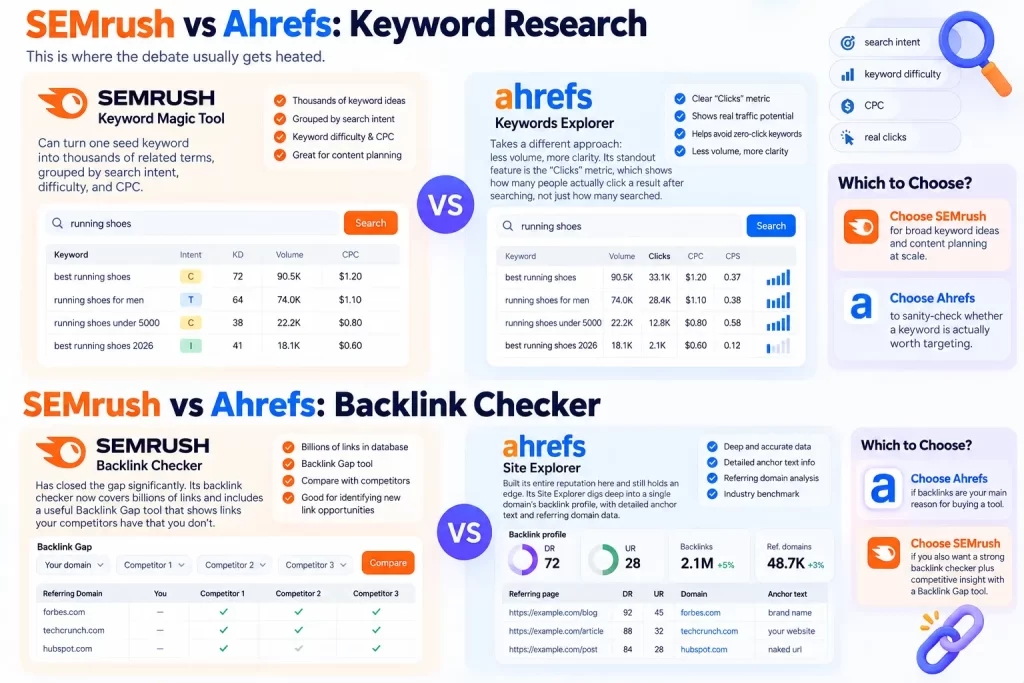
SEMrush’s Keyword Magic Tool can turn one seed keyword into thousands of related terms, grouped by search intent, difficulty, and CPC. If you’re building a large content calendar and need volume, it’s hard to beat.
Ahrefs’ Keywords Explorer takes a different approach: less volume, more clarity. Its standout feature is the “Clicks” metric, which shows how many people actually click a result after searching, not just how many people searched the term. A keyword can get thousands of monthly searches and almost no clicks, because Google answers it directly on the results page. Ahrefs flags that before you waste time writing for it.
- Choose SEMrush for broad keyword ideas and content planning at scale.
- Choose Ahrefs to sanity-check whether a keyword is actually worth targeting.
SEMrush vs Ahrefs: Backlink Checker
Ahrefs built its entire reputation here and still holds an edge. Its Site Explorer digs deep into a single domain’s backlink profile, with detailed anchor text and referring domain data that link builders consistently point to as the industry benchmark.
SEMrush has closed the gap significantly. Its backlink checker now covers billions of links and includes a useful Backlink Gap tool that shows links your competitors have that you don’t.
If backlinks are your main reason for buying a tool, Ahrefs generally wins. If you want solid backlink data bundled with everything else, SEMrush covers the basics well.
Site Audit and Technical SEO
Nobody enjoys crawling their own site for broken links and duplicate content, but it has to happen regularly.
SEMrush’s Site Audit tool is often praised for how clearly it explains problems. It doesn’t just list errors; it prioritizes them and tells you what to fix first, which helps if you’re not a technical SEO expert.
Ahrefs’ Site Audit covers similar ground with detailed reports on page speed, HTML tags, and internal linking. It tends to appeal more to users who already understand technical SEO terminology and just want the raw data fast.
Both schedule automatic crawls and alert you when new issues appear, so neither tool will leave you flying blind between visits.
Competitor Analysis
One of the biggest reasons people buy either tool is competitor research.
With SEMrush, you can plug in a competitor’s domain and instantly see their top organic keywords, paid ads, and traffic trends. The Keyword Gap tool then shows exactly which keywords they rank for that you don’t.
Ahrefs offers a similar workflow through Site Explorer and Content Gap. You can see a competitor’s top pages by traffic, their backlink sources, and which keywords are driving the most visits.
Both are genuinely useful here. The underlying data is fairly comparable, so the deciding factor is usually which interface feels more natural to you.
Rank Tracking and Local SEO
SEMrush’s Position Tracking tool updates daily by default and splits results by device, location, and search engine, including Bing and Baidu, which matters if you sell outside Google-dominated markets.
Ahrefs keeps its rank tracker simpler, refreshing weekly by default on most plans, with manual updates available. Some users find the slower cadence limiting if they need to react quickly to a sudden ranking drop.
For local businesses, both platforms offer location tracking down to the city or zip code level, so this is worth testing in both tools before you commit if you manage several store locations.
Database Size: SEMrush vs Ahrefs
Bigger isn’t always better, but database size still affects keyword and backlink coverage.
SEMrush reports a keyword database north of 25 billion keywords across more than 140 country databases, plus a backlink index tracking tens of trillions of links.
Ahrefs reports a slightly smaller keyword database but pulls data from ten search engines instead of focusing mostly on Google, and its referring domain index is often cited as one of the freshest in the industry thanks to its aggressive crawler.
In practice, both databases are large enough that most everyday users will never hit a wall. This metric matters more for enterprise teams working across dozens of markets and languages.
Ease of Use and Learning Curve
SEMrush is generally considered more beginner friendly, with guided workflows and free courses through SEMrush Academy. Its dashboards can still feel data-heavy once you dig past the surface, though.
Ahrefs has a cleaner, more minimal interface. Experienced SEOs often say it “just makes sense” once you understand core concepts like backlinks and SERPs, but total beginners sometimes find it assumes too much prior knowledge.
Support, Integrations, and the Practical Stuff
Features get most of the attention in these comparisons, but the day-to-day details matter just as much once you’re actually paying for a subscription.
Onboarding and support: SEMrush leans on guided onboarding, in-app tips, and a large help center, with live chat support on paid plans. Ahrefs offers thorough documentation and video guides, with support response times that most users describe as solid rather than instant.
Integrations: Both connect with Google Analytics, Google Search Console, and Google Business Profile. SEMrush also integrates with common CMS platforms and social schedulers, given its broader marketing focus.
Data export and API access: Both tools support CSV export across most reports, and both offer API access on higher tiers for teams that want to pull data into their own dashboards.
Team collaboration: SEMrush plans generally include more built-in collaboration and reporting features for agencies managing multiple clients. Ahrefs plans, by contrast, typically include just one seat per plan, so extra team members mean extra cost.
Mobile app, uptime, and security: Neither tool has a full-featured native mobile app; both are primarily desktop, browser-based platforms. Both report strong uptime and standard security practices, though you should check each vendor’s current security and compliance documentation if that matters for your business.
Refund policy: SEMrush’s refund terms are tied to its free trial window. Ahrefs generally doesn’t offer refunds outside specific billing errors, since it skips the traditional trial model.
SEMrush vs Ahrefs Pricing
| Plan Tier | SEMrush | Ahrefs |
|---|---|---|
| Entry | SEO: $117.33/mo billed annually ($139/mo monthly) | Lite: $129/month |
| Mid | Starter: $165.17/mo billed annually ($199/mo monthly) | Standard: $249/month (tested for this review) |
| Higher | Pro+: $248.17/mo billed annually ($299/mo monthly) (tested for this review) | Advanced: $449/month |
| Top | Advanced: $455.67/mo billed annually ($549/mo monthly) | Enterprise: custom pricing |
| Free trial | “Try for free” on SEO, Starter, and Pro+ plans | No self-serve trial; free Ahrefs Webmaster Tools instead |
Figures confirmed directly from current SEMrush and Ahrefs pricing pages. SEMrush’s rates above are its discounted annual-billing price; month-to-month costs more (shown in parentheses). Ahrefs also sells a lower $29/month Starter tier below Lite, aimed at very light, single-project use.
For this review, we tested SEMrush Pro+ against Ahrefs Standard, since the two land within about a dollar of each other ($248.17 vs. $249/month) and both unlock the fuller feature set serious SEO work actually needs, rather than the stripped-down entry tiers. If budget is tighter, SEMrush’s SEO plan ($117.33/mo) and Ahrefs’ Lite plan ($129/mo) are the cheaper starting points worth knowing about, though a few features referenced in this review (like Ahrefs’ Content Explorer) aren’t available at that lower tier.
Pros and Cons
SEMrush
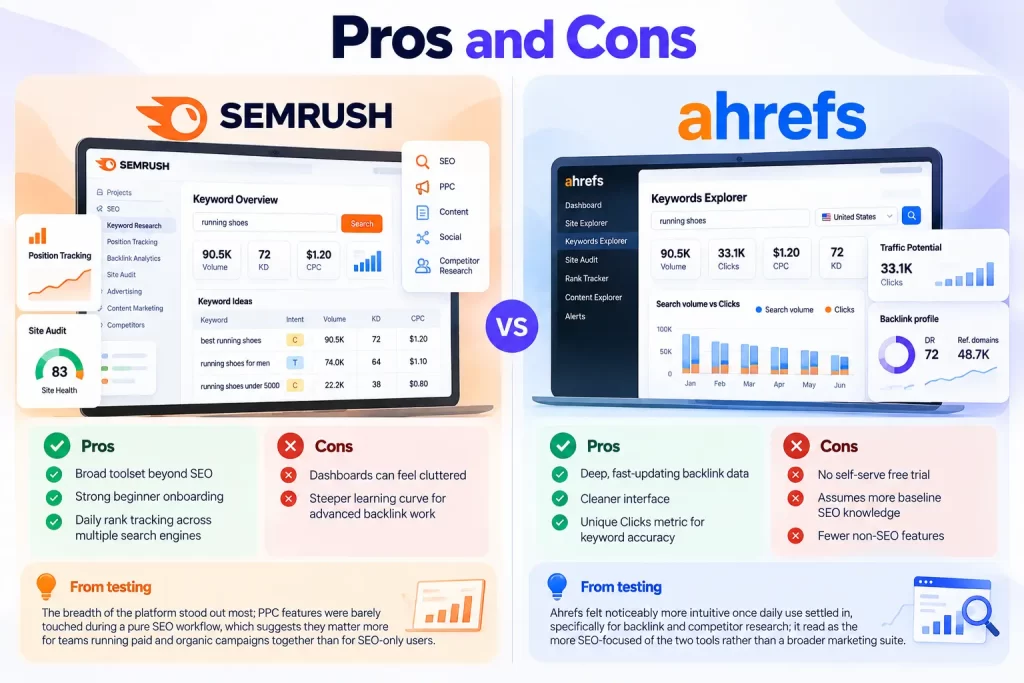
- Pros: broad toolset beyond SEO, strong beginner onboarding, daily rank tracking across multiple search engines
- Cons: dashboards can feel cluttered, steeper learning curve for advanced backlink work
- From testing: the breadth of the platform stood out most; PPC features were barely touched during a pure SEO workflow, which suggests they matter more for teams running paid and organic campaigns together than for SEO-only users.
Ahrefs
- Pros: deep, fast-updating backlink data, cleaner interface, unique Clicks metric for keyword accuracy
- Cons: no self-serve free trial, assumes more baseline SEO knowledge, fewer non-SEO features
- From testing: Ahrefs felt noticeably more intuitive once daily use settled in, specifically for backlink and competitor research; it read as the more SEO-focused of the two tools rather than a broader marketing suite.
Who It’s For, and Who Should Skip It
SEMrush fits you if: you’re new to SEO, you want one login for SEO plus PPC and content, or you’re a small business trying to consolidate several tools into one subscription. If you’re weighing this kind of software spend against other priorities, having your budget mapped out first helps.
Skip SEMrush if: you only care about deep backlink analysis and don’t need PPC, social, or content tools cluttering your dashboard.
Ahrefs fits you if: backlinks and technical accuracy are your top priority, you already understand core SEO concepts, and you want a lean, focused toolset. It’s also worth a look if you’re building a business on a tight budget, thanks to its $29 entry tier.
Skip Ahrefs if: you’re a total beginner who needs guided tutorials, or you want PPC and social features bundled in.
If you’re planning either subscription as a recurring line item, it’s worth running it against your actual numbers first.
Alternatives Worth Knowing About
Moz is the budget-friendly middle ground. Its database is smaller than SEMrush or Ahrefs, and keyword suggestion limits can feel restrictive, but its Domain Authority metric is still widely recognized, and the interface is arguably the simplest of the three.
Both SEMrush and Ahrefs have also leaned into AI visibility tracking recently, helping you see how your brand shows up in AI-generated answers, not just traditional blue links. That shift is part of a bigger pattern; see our piece on for how the same underlying technology is reshaping other industries too.
Frequently Asked Questions
Neither is universally “better.” SEMrush suits people who want an all-in-one marketing platform with beginner-friendly guidance. Ahrefs suits people focused on backlink analysis and technical SEO accuracy. Your goals should decide the winner.
Ahrefs has the cheapest true entry point with its $29/month Starter tier, aimed at very light use. SEMrush’s SEO plan ($117.33/month billed annually) and Ahrefs’ Lite plan ($129/month) are the next cheapest, close to each other in price. For this review, we tested each vendor’s mid-tier plan instead, SEMrush Pro+ ($248.17/month) and Ahrefs Standard ($249/month), since they land almost exactly together in price and unlock the fuller feature set.
SEMrush generally wins on sheer keyword volume and content planning. Ahrefs wins on accuracy, thanks to its Clicks metric, which shows whether a keyword actually drives clicks or gets absorbed by featured snippets and AI answers.
Ahrefs is widely considered the stronger tool specifically for backlink data, thanks to its aggressive crawler and detailed referring domain reports. SEMrush has improved significantly here but still trails Ahrefs for most users.
SEMrush typically offers a free trial of around 7 days on its paid plans. Ahrefs doesn’t run a traditional free trial, but offers Ahrefs Webmaster Tools, a free (limited) version for auditing your own verified site.
Final Verdict
There’s no universal winner here, and any review that tells you otherwise is oversimplifying.
- Pick SEMrush if you want one platform for SEO, PPC, content, and social, and you value beginner-friendly guidance.
- Pick Ahrefs if backlinks and technical accuracy are your top priority and you’re comfortable with a steeper learning curve.
- Pick both, eventually, if budget allows. Plenty of working SEOs end up running both, using each one for what it does best.
Ready to try one for yourself? You can start a free trial, or go straight to SEMrush.com if you’d rather sign up without an affiliate link. For Ahrefs, head to Ahrefs.com to test the Starter plan, Ahrefs doesn’t run an affiliate program, so this is a direct link either way, with no commission for us. Cross-check both against independent reviews on G2 before you commit.