



Picking an Ecommerce Platform in India Is Harder Than It Looks. Rahul makes handmade leather wallets in Kanpur. Last year he sold on Instagram DMs and collected money over UPI. It worked, until he hit 30 orders a week. Then came the chaos: lost addresses, missed COD calls and a notebook full of half-written invoices.
- What Is an Ecommerce Platform? (And the 3 Types You Will Meet)
- Best Ecommerce Platform in India: Comparison Table
- The Best Ecommerce Platforms in India 2026, Reviewed
- Which Ecommerce Platform Is Best for Your Type of Business?
- The True Cost of an Online Store in India
- Payments, Shipping and GST: The India Checklist
- ONDC and WhatsApp Commerce: The 2026 Channels to Watch
- Own Website vs Amazon, Flipkart and Meesho: Which Is the Best Platform to Sell Online in India?
- Conclusion: Pick the Platform That Fits Your Stage
- Frequently Asked Questions
So he decided to build a proper online store. Simple, right?
Not quite. He opened ten “best platform” articles and found ten different winners. Many were written by the platforms themselves. Prices were in dollars. Nobody explained whether COD worked, or what a “transaction fee” would actually cost him.


If that sounds like you, this guide is for you. We compared the best ecommerce platforms in India the way a seller would, not the way a vendor would. You will get:
- A neutral comparison table with INR pricing, fees, COD, UPI, Shiprocket, GST and ONDC support
- Honest reviews of Shopify, WooCommerce, Dukaan, Wix, Zoho Commerce, Instamojo and India-built options
- A “which platform for which seller” matrix
- The true cost of running a store, beyond the monthly plan
- A clear answer to the big question: own website or Amazon, Flipkart and Meesho?
Let us start with the basics.
What Is an Ecommerce Platform? (And the 3 Types You Will Meet)
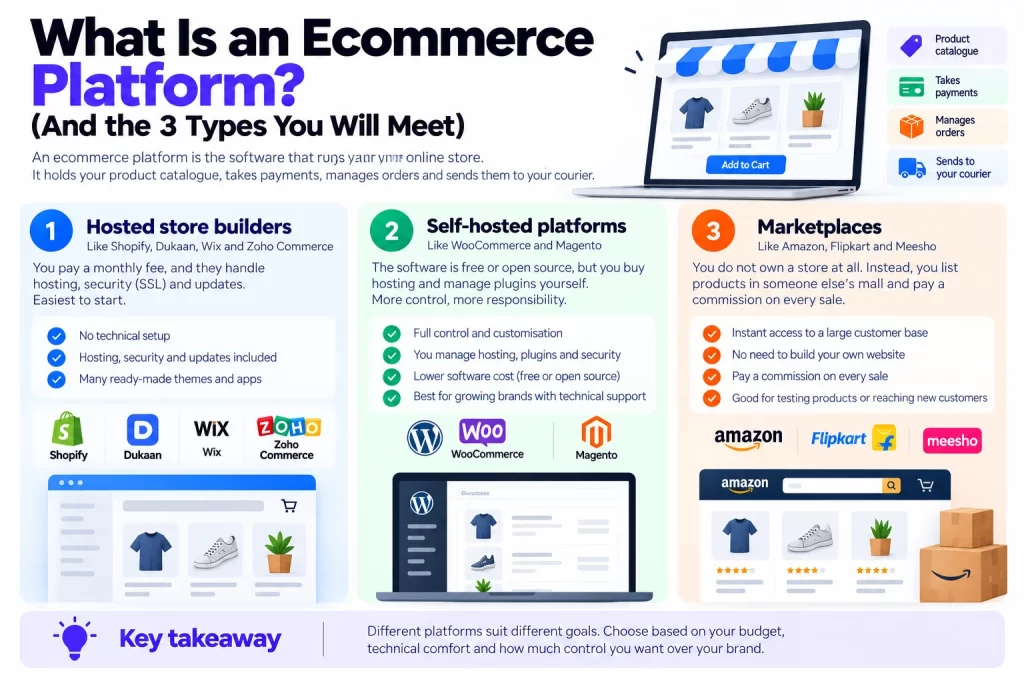
An ecommerce platform is the software that runs your online store. It holds your product catalogue, takes payments, manages orders and sends them to your courier.


Think of it like renting a shop. Some options give you a ready-furnished shop in a mall. Others hand you an empty plot and let you build. In India, you will meet three types:
- Hosted store builders like Shopify, Dukaan, Wix and Zoho Commerce. You pay a monthly fee, and they handle hosting, security (SSL) and updates. Easiest to start.
- Self-hosted platforms like WooCommerce and Magento. The software is free or open source, but you buy hosting and manage plugins yourself. More control, more responsibility.
- Marketplaces like Amazon, Flipkart and Meesho. You do not own a store at all. Instead, you list products in someone else’s mall and pay a commission on every sale.
Most of this guide focuses on the first two, because that is where you build your own brand. We cover marketplaces near the end.


How we compared these platforms
We tested each platform on its free trial or free plan and asked the questions an Indian seller actually asks:
- What does it cost in rupees? Including transaction fees, not just the headline plan.
- Does checkout support UPI and COD? And does it connect to Razorpay, Cashfree or PayU?
- Can it ship easily? Through Shiprocket, Delhivery or a similar aggregator.
- Is it GST-ready? Can it create proper GST invoices with your GSTIN?
- Can a non-tech owner run it? No developer on speed dial.
Best Ecommerce Platform in India: Comparison Table
Here is the neutral side-by-side view. Starting prices are for the entry plan.
| Platform | Type | Starting cost (INR) | Extra transaction fee | COD + UPI | Shiprocket | GST invoices | Hindi storefront |
|---|---|---|---|---|---|---|---|
| Shopify | Hosted | ₹1,499/mo (yearly) or ₹1,994/mo (monthly) | 2% on Basic with third-party gateways | Yes, via Razorpay, Cashfree, PayU | Yes (app) | Yes (app) | Yes |
| WooCommerce | Self-hosted | Free plugin + hosting | None from WooCommerce | Yes, via gateway plugins | Yes (plugin) | Yes (plugin) | Yes (plugin) |
| Dukaan | Hosted | Free trial, then INR plans | Check current plan | Yes | Yes | Yes | Yes |
| Wix | Hosted | INR business plans | None from Wix | Yes, via supported gateways | Via integration | Basic | Yes |
| Zoho Commerce | Hosted | Free trial, then INR plans | Check current plan | Yes | Yes | Yes, built in | Limited |
| Instamojo | Hosted | Free plan available | Payment fee per order | Yes | Yes | Basic | Limited |
Prices and features change often, so confirm on each vendor’s pricing page before you sign up. Shopify figures are from its India pricing page as of October 2026.
What about ONDC? Most sellers join ONDC through a seller app (a registered network partner), whichever store platform they use. So treat ONDC as an extra sales channel rather than a platform feature.
The Best Ecommerce Platforms in India 2026, Reviewed
Now let us look at each platform up close: who it suits, where it shines and where it hurts.
1. Shopify: best overall for growing D2C brands
Shopify is the default choice for serious D2C brands, and for good reason. Setup is quick, the themes look professional and its app store solves almost any problem you will hit.
What we like:
- Clean checkout that converts well on mobile
- Thousands of apps for reviews, upsells, WhatsApp alerts and GST invoices
- Easy Shiprocket and Delhivery integrations
- Strong page speed and SEO-friendly URLs out of the box
What to watch:
- Shopify pricing in India starts at ₹1,499 a month on yearly billing for the Basic plan. Monthly billing costs more.
- If you use Razorpay, Cashfree or another third-party gateway, Shopify adds a 2% transaction fee on Basic. That drops to 1% on Grow and 0.6% on Advanced.
- Paid apps add up quickly. Five apps at ₹500 each is another ₹2,500 a month.
Best for: D2C brands doing steady monthly sales that want room to scale.
2. WooCommerce: best for control and low fees
WooCommerce is a free plugin that turns a WordPress site into a store. You pay for hosting, a theme and any premium plugins, but WooCommerce itself charges no transaction fee.
So is Shopify vs WooCommerce in India a simple choice? Not quite. Here is the trade-off:
- WooCommerce is cheaper to run at scale and gives full control over design and data. However, you handle updates, backups, security and speed.
- Shopify costs more each month, but it just works. You spend time on selling, not on fixing plugins.
Slow page speed is the most common WooCommerce complaint. Good hosting and a light theme fix most of it.
Best for: sellers comfortable with WordPress, content-heavy brands and anyone who wants to avoid platform fees.
3. Dukaan: best for first-time sellers on mobile
Dukaan started as a “store in 30 seconds” app for kirana shops and small sellers. It still shines at speed and simplicity. You can build a store from your phone, share it on WhatsApp and accept UPI and COD.
On the downside, design options are more limited than Shopify, and pricing plans have changed several times. Check the current plan before you commit.
Best for: first-time sellers, offline retailers moving online and Instagram or WhatsApp sellers.
4. Wix: best for design-led small brands
Wix is a drag-and-drop website builder with solid ecommerce features. It is easy to make a store that looks unique, which helps for boutiques, artists and handmade brands.
However, India-specific tools such as Shiprocket and GST invoicing need integrations or workarounds. For a store with a few dozen products, that is fine. For hundreds of SKUs, Shopify or WooCommerce handles inventory better.
Best for: small, design-focused stores that also need a strong brand website.
5. Zoho Commerce: best for GST and back-office in one place
Zoho Commerce is built by an Indian company and plugs straight into Zoho Books, Zoho Inventory and Zoho CRM. That means GST invoices, e-invoicing and stock sync come built in rather than bolted on.
The storefront themes are simpler than Shopify’s. Still, if you already run your accounts on Zoho, it saves a lot of double entry.
Best for: B2B sellers, wholesalers and businesses that care more about clean accounts than fancy design.
6. Instamojo: best free ecommerce website builder in India to test an idea
Instamojo began as a payment link tool and now offers a free online store. Instead of a monthly fee, you mainly pay a payment fee on each order.
It is a low-risk way to test whether people will actually buy your product. Once orders grow, though, many sellers move to Shopify or WooCommerce for better design and apps.
Best for: solopreneurs, creators and anyone testing a product with zero upfront cost.
7. Other Indian ecommerce platforms worth a look
India now has several homegrown store builders with INR billing, local support and India-first features:
- Shopaccino: feature-rich, with good B2B and multi-store options
- StoreHippo: aimed at larger brands and marketplaces, with headless commerce options
- DotPe: popular with restaurants and food businesses for QR and WhatsApp ordering
Also worth knowing: BigCommerce and Magento (Adobe Commerce) suit large brands with big catalogues and in-house tech teams. For most small sellers, they are more than you need.
Tip: Whichever platform you pick, AI can cut your setup time in half. Our guide to the best AI tools for small business in India covers tools for product descriptions, photos and WhatsApp replies. Using ChatGPT Go for listings? Note that the ChatGPT Go free offer in India is ending.
Which Ecommerce Platform Is Best for Your Type of Business?
There is no single “best” platform. There is only the best fit for your stage and model. Use this matrix as a shortcut.
| Seller type | Best pick | Strong alternative | Why |
|---|---|---|---|
| First-time seller, tight budget | Instamojo or Dukaan | WooCommerce | Low or zero upfront cost, quick setup |
| Growing D2C brand | Shopify | WooCommerce | Apps, speed and easy scaling |
| Offline retailer or kirana going online | Dukaan | DotPe | Mobile-first, WhatsApp sharing, UPI |
| Wholesaler or B2B seller | Zoho Commerce | Shopaccino | GST, inventory and accounts in one place |
| Clothing or jewellery brand | Shopify | Wix | Strong visual themes and variant handling |
| Food or restaurant business | DotPe | Dukaan | QR menus and WhatsApp ordering |
| Content-led or blog-first brand | WooCommerce | Shopify | WordPress SEO and full content control |
Still unsure? Ask yourself one question: will I spend more time selling or fixing the website? If the answer scares you, pick a hosted platform.
The True Cost of an Online Store in India
The plan price is only the start. Many sellers are surprised when the first full month’s bill arrives. Here is what you really pay for:
- Platform subscription: ₹0 to about ₹2,000 a month for most entry plans.
- Domain name: about ₹500 to ₹1,000 a year for a .com or .in.
- Theme: free themes work fine at first. Premium themes are usually a one-time cost.
- Apps or plugins: reviews, upsells, WhatsApp alerts and GST invoices. Budget ₹1,000 to ₹3,000 a month on Shopify as you grow.
- Payment gateway fees: Razorpay, Cashfree and PayU typically charge around 2% per online transaction. UPI is often cheaper, so check your plan.
- Platform transaction fee: 2% on Shopify Basic if you use a third-party gateway. Zero on WooCommerce.
- Shipping and COD charges: courier rates plus a COD fee per order through Shiprocket or similar.
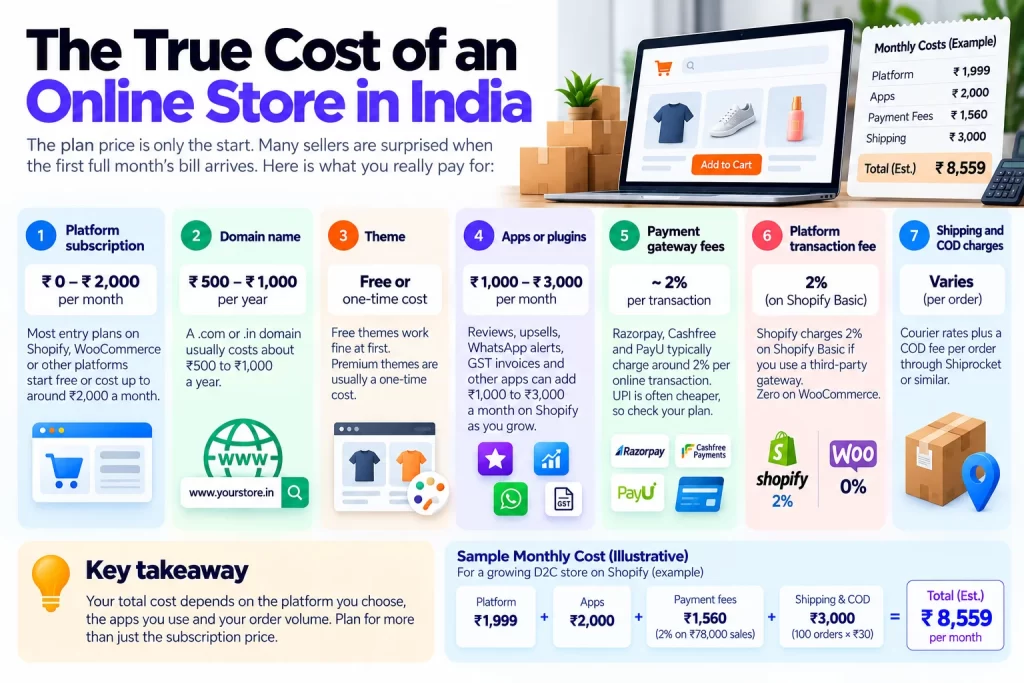
A quick example: a store doing ₹1 lakh a month on Shopify Basic with Razorpay pays roughly ₹2,000 in gateway fees and another ₹2,000 in Shopify’s transaction fee, plus the plan and apps. On WooCommerce, that second ₹2,000 disappears, but hosting and maintenance take some of it back.
So the cheapest ecommerce platform in India depends on your sales. At low volume, a free plan wins. At higher volume, transaction fees matter more than the subscription.
Payments, Shipping and GST: The India Checklist
These three decide whether your store actually works for Indian buyers.
UPI and COD at checkout
Indian shoppers expect UPI, and many still prefer cash on delivery, especially in Tier-2 and Tier-3 towns. Every platform above supports both through gateways like Razorpay, Cashfree, PayU or PhonePe PG.
However, COD brings a hidden cost: returned orders, also called RTO. To reduce it:
- Offer a small prepaid discount, such as 5% off for UPI
- Confirm COD orders on WhatsApp before you ship
- Block pincodes with very high return rates
Shipping integrations
An aggregator like Shiprocket connects you to many couriers, such as Delhivery, Blue Dart and Xpressbees, from one dashboard. It checks pincode serviceability, prints labels and tracks orders. Shopify, WooCommerce, Dukaan and Zoho Commerce all connect to it easily.
GST invoices
Do you need GST to sell online? If you sell through marketplaces like Amazon or Flipkart, GST registration is generally required. Meesho is an exception for many small sellers, so see our guide on how to sell on Meesho without GST. Selling on your own website has different thresholds, so check with your CA.
Either way, your platform should create GST-compliant invoices with your GSTIN, HSN codes and tax breakup. Zoho Commerce does this natively. Shopify and WooCommerce need an app or plugin.
ONDC and WhatsApp Commerce: The 2026 Channels to Watch
ONDC (Open Network for Digital Commerce) is a government-backed network that lets buyers on one app purchase from sellers on another. For small sellers, it means reach without a big marketplace commission. You join through a registered seller app, and you can learn more on the official ONDC website.
WhatsApp commerce is the other big shift. Many buyers now prefer to browse a catalogue, ask questions and pay without ever leaving WhatsApp. Dukaan and DotPe make this easy, while Shopify and WooCommerce connect to WhatsApp tools through apps.
Once your store is live, traffic is the next challenge. Our roundup of the best marketing software for small businesses in India covers email, WhatsApp and social tools that bring buyers back.
Own Website vs Amazon, Flipkart and Meesho: Which Is the Best Platform to Sell Online in India?
This is the question almost every seller asks. Should you build your own store or list on a marketplace?
Here is the honest answer: most successful Indian brands do both. Marketplaces bring buyers. Your own store builds a brand and keeps more margin.
| Factor | Amazon / Flipkart | Meesho | Own store (Shopify, WooCommerce etc.) |
|---|---|---|---|
| Ready-made traffic | Very high | High, value-focused buyers | None at first, you bring it |
| Fees per sale | Referral fee + closing fee + shipping, varies by category | Zero commission model, but low price points | Gateway fee + platform fee only |
| Customer data | Stays with the marketplace | Stays with the marketplace | Yours to keep |
| Brand control | Limited | Very limited | Full |
| GST registration | Generally required | Generally required | Depends on your turnover, check with your CA |
When to start with a marketplace
- You have no audience yet and need sales quickly
- Your product is a commodity people already search for
- You want to test demand before investing in a brand
When to build your own store
- You sell a branded or niche product with repeat buyers
- You want customer data for WhatsApp and email marketing
- Marketplace commissions are eating most of your profit
So what does a smart path look like? Start on one marketplace to learn what sells. Meesho is the easiest place to begin, and our step-by-step guide to selling on Meesho walks you through it. Then open your own store, and slowly move loyal buyers there with a first-order discount on your website.
Of course, your own store only works if people find it. Our list of the best SEO tools for small businesses in 2026 is a good next step, and our Semrush vs Ahrefs comparison helps you pick the right one.
Conclusion: Pick the Platform That Fits Your Stage
The best ecommerce platform in India is the one that fits your budget, your products and how much time you can spend on tech. Here is the short version:
- Shopify for growing D2C brands that want speed and apps
- WooCommerce for control and zero platform fees
- Dukaan for first-time and mobile-first sellers
- Wix for design-led small brands
- Zoho Commerce for GST, inventory and B2B selling
- Instamojo to test an idea for free
- Marketplaces plus your own store for the best of both worlds
Above all, look beyond the plan price. Transaction fees, apps, COD returns and shipping decide whether your store makes money.
Your next step: pick two platforms from the matrix above and start their free trials this week. Add five products, run a test order with UPI and COD, and see which one feels easier. Then explore more honest, India-first software comparisons on the Finodeal blog before you spend a rupee.
Frequently Asked Questions
For most small businesses, Shopify is the best all-rounder, while Dukaan and Instamojo suit first-time sellers on a tight budget. If you already use WordPress, WooCommerce is a strong low-fee option. Choose based on your budget, product count and comfort with tech.
Yes. Instamojo offers a free online store, and WooCommerce is a free plugin, although you still pay for hosting and a domain. Most hosted platforms, including Shopify, Dukaan and Zoho Commerce, also offer free trials so you can test before paying.
Shopify’s Basic plan costs ₹1,499 a month on yearly billing, or ₹1,994 on monthly billing, as of October 2026. If you use a third-party gateway like Razorpay, Shopify adds a 2% transaction fee on Basic. Apps and themes are extra.
Shopify, WooCommerce, Dukaan, Zoho Commerce and Instamojo all support COD and UPI through gateways such as Razorpay, Cashfree and PayU. Most of them also integrate with Shiprocket for courier booking, pincode checks and tracking. Wix may need an extra integration for Indian shipping.
Ideally, use both. Marketplaces give you instant traffic but charge commissions and keep customer data. Your own website builds your brand, keeps margins higher and lets you sell again to the same buyers. Many sellers start on a marketplace and then grow their own store over time.