



You’ve built the website. Your products are ready. Then you hit the question every online seller faces: how do I actually collect money?
- What Is a Payment Gateway, and How Do the Charges Work?
- Top 10 Payment Gateways in India: Charges Compared
- The 10 Best Payment Gateways in India, Reviewed
- Documents You Need to Open a Payment Gateway Account
- How to Choose the Best Payment Gateway in India for Your Business
- Final Thoughts: Pick the Gateway That Fits How You Sell
- Frequently Asked Questions
That’s where a payment gateway comes in. It’s the digital cash counter of your online store. It takes the customer’s UPI, card or netbanking payment and moves the money safely into your bank account.
But here’s the tricky part. Most gateways look alike on the surface. Almost all say “2% fee” and “easy setup.” The real differences hide in the details, like UPI fees, international card charges, settlement speed and offers for new businesses.


So we checked the official pricing pages and put together this list of the top 10 payment gateways in India for 2026. Here’s what you’ll find:
- How payment gateway charges work, in plain language
- A side-by-side comparison table of all 10 gateways
- A closer look at each gateway’s fees, features, pros and cons
- A simple checklist to pick the best payment gateway for your business
- Answers to common questions about UPI fees, setup costs and more
Note: Prices change often, and many gateways offer custom rates. We’ve listed public rates as of October 2026. Always confirm on the provider’s site before signing up.
What Is a Payment Gateway, and How Do the Charges Work?
A payment gateway connects your website or app to banks, card networks and UPI. When a customer clicks “Pay,” the gateway checks the payment, gets approval and later settles the money in your bank account.

Think of it like a toll booth on a highway. Every car (payment) passes through, and the booth keeps a small fee for the service. Your job is to find the booth with fair fees and short queues.
The main costs to know
When you compare payment gateway charges, look at these five things:


- Transaction fee (TDR or platform fee): a percentage of every successful payment. For most gateways in India, it’s around 2% + 18% GST on the fee.
- Setup fee: a one-time charge to open your account. Most big gateways now charge zero.
- Annual maintenance charge (AMC): a yearly fee. Some gateways skip it, while others charge a small amount after year one.
- International and premium cards: Amex, Diners and foreign cards usually cost more, often 3% to 4.5%.
- Extras: instant settlements, payment links, subscriptions and payouts can carry separate fees.
What about UPI payments?
Here’s something many sellers don’t know. Under government rules, bank-to-bank UPI and RuPay debit card payments carry zero MDR (merchant discount rate).
However, that doesn’t always mean your UPI payments are free. Some gateways still charge a platform fee for their service. For example, Razorpay’s pricing page states that UPI has no MDR, but its 2% platform fee still applies. So always check how a gateway prices UPI, especially if most of your customers pay that way.
Why GST matters
One more thing. The 18% GST is charged on the gateway’s fee, not on your sale. So a “2%” fee actually costs about 2.36% of each payment. On a ₹1,000 order, that’s roughly ₹23.60.
It sounds small. But at ₹10 lakh in monthly sales, the gap between a 1.95% and a 2% fee adds up over a year.
Top 10 Payment Gateways in India: Charges Compared
Here’s a quick side-by-side look. Rates are standard public rates before 18% GST, checked in October 2026.
| Gateway | Standard domestic fee | International / premium cards | Setup fee | Best for |
|---|---|---|---|---|
| Razorpay | 2% | 3% (Amex, Diners, international) | ₹0 | Startups and growing online brands |
| PayU | 2% | 3% (Amex, Diners, EMI, international) | ₹0 | Established ecommerce businesses |
| Cashfree | 1.95% | 2.99% (international Visa/Mastercard) | ₹0 | Cost-conscious businesses and payouts |
| CCAvenue | 2% (Standard plan, incl. UPI) | 3% (international, Amex, Diners) | ₹0 | Businesses needing many payment options |
| Paytm | 1.99% | Not listed publicly | ₹0 | Brands whose customers use Paytm |
| PhonePe | Free during offer (was 1.99%) | Not listed publicly | ₹0 | UPI-heavy small businesses |
| Instamojo | 2% + ₹3 | 3% + ₹3 (corporate cards) | ₹0 | Creators and very small sellers |
| Easebuzz | Custom pricing | Custom pricing | ₹0 | Education and fee collection |
| PayPal | No domestic payments | 4.4% + fixed fee | ₹0 | Receiving payments from abroad |
| Stripe | 2% (Indian cards) | 3% (foreign cards), 4.3% (USD/foreign currency) | ₹0 | Invite-only; global SaaS brands |
Tip: Many gateways run launch offers. Razorpay offers 0% fees on the first ₹5 lakh or 90 days for newly activated accounts, Cashfree offers zero platform fees on the first ₹20 lakh of domestic sales for new merchants, and PhonePe shows its standard plan as free during its current offer. Each comes with terms, so read the fine print.
The 10 Best Payment Gateways in India, Reviewed
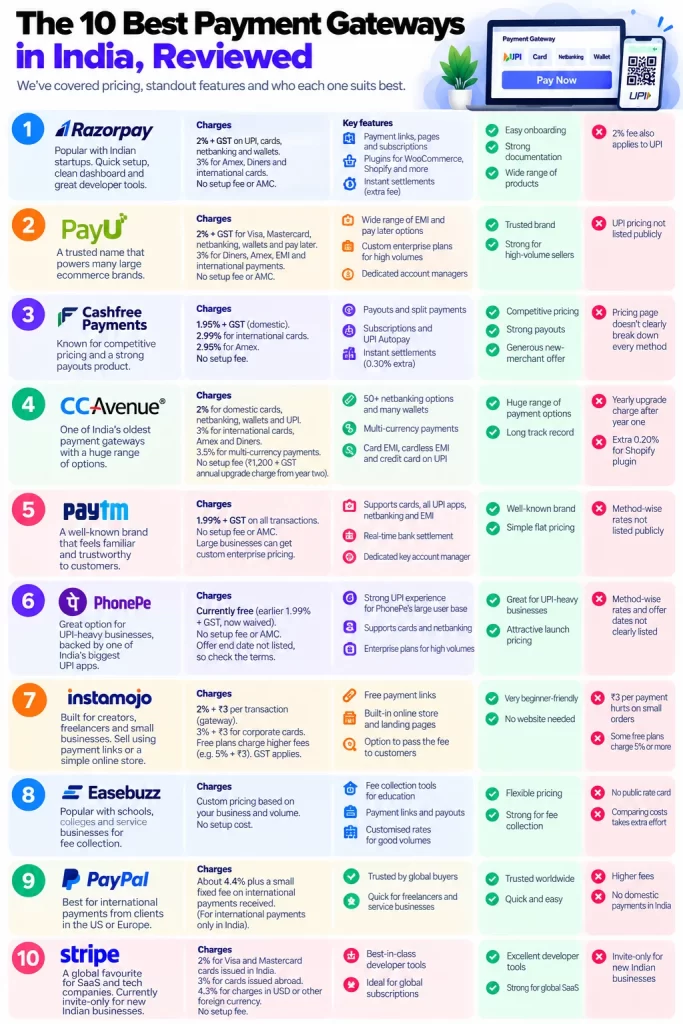
Now let’s look at each gateway in detail. We’ve covered pricing, standout features, and who each one suits best.
1. Razorpay
Razorpay is one of the most popular choices for Indian startups, and it’s easy to see why. Setup is quick, the dashboard is clean, and the developer tools are well documented.
Charges: 2% + GST on UPI, domestic cards, netbanking and wallets. Amex, Diners and international cards cost 3%. There’s no setup fee or AMC on standard accounts. Accounts activated from 1 July 2026 get 0% platform fees on domestic payments for 90 days or the first ₹5 lakh, whichever comes first (Amex, Diners, corporate cards and EMI excluded).
Key features:
- Payment links, payment pages and subscriptions
- Plugins for WooCommerce, Shopify and other platforms
- Instant settlements (extra fee)
Pros: easy onboarding, strong documentation, wide range of products.
Cons: the 2% platform fee also applies to UPI, which matters if most of your sales come through UPI.
2. PayU
PayU has been around in India for years and powers many large ecommerce brands. If you’ve ever searched for the PayU India payment gateway, you’ll know it’s a familiar name at checkout.
Charges: 2% + GST for Visa, Mastercard, netbanking, wallets and pay later. Diners, Amex, EMI and international payments cost 3%. The standard plan has no setup fee and no AMC. UPI pricing depends on your business type and volume.
Key features:
- Wide range of EMI and pay later options
- Custom enterprise plans for high volumes
- Dedicated account managers on enterprise plans
Pros: trusted brand, strong for high-volume sellers.
Cons: UPI pricing isn’t listed publicly, so you’ll need to ask sales.
3. Cashfree Payments
Cashfree stands out for slightly lower standard pricing and a strong payouts product. That makes it popular with marketplaces and businesses that also need to pay vendors or customers.
Charges: 1.95% + GST as the standard domestic platform fee. International Visa and Mastercard cost 2.99%, and Amex costs 2.95%. There’s no setup fee. New merchants can get zero platform fees on the first ₹20 lakh of domestic sales, until 31 March 2027 (terms apply).
Key features:
- Payouts and split payments for marketplaces
- Subscriptions and UPI Autopay
- Instant settlements (0.30% extra)
Pros: competitive pricing, strong payouts, generous new-merchant offer.
Cons: its pricing page doesn’t clearly break down every payment method.
4. CCAvenue
CCAvenue is one of India’s oldest payment gateways. Its biggest strength is choice: it supports a long list of cards, netbanking banks, wallets and currencies.
Charges: On the Standard plan, domestic cards, netbanking, wallets and UPI cost 2%. International cards, Amex and Diners cost 3%, and multi-currency payments cost 3.5%. There’s no setup fee, but an annual software upgrade charge of ₹1,200 + GST applies from the second financial year.
Key features:
- 50+ netbanking options and many wallets
- Multi-currency payments
- Card EMI, cardless EMI and credit card on UPI options
Pros: huge range of payment options, long track record.
Cons: a yearly upgrade charge after year one, and an extra 0.20% if you use its Shopify plugin.
5. Paytm Payment Gateway
Millions of Indians already use Paytm. So adding it to your checkout can feel familiar and trustworthy to customers.
Charges: The standard plan charges a 1.99% platform fee + GST on all transactions. There’s no setup or maintenance cost. Large businesses can ask for custom enterprise pricing.
Key features:
- Supports cards, all UPI apps, netbanking and EMI
- Real-time bank settlement
- Dedicated key account manager
Pros: well-known brand, simple flat pricing.
Cons: method-wise rates aren’t listed publicly.
6. PhonePe Payment Gateway
PhonePe is one of India’s biggest UPI apps, and its payment gateway builds on that strength. If most of your customers pay by UPI, it’s worth a look.
Charges: PhonePe’s pricing page shows its standard plan as free during a current offer, with the earlier 1.99% rate struck out. There’s no setup fee or annual maintenance fee. The offer end date isn’t listed, so check the terms before you plan around it.
Key features:
- Strong UPI experience for PhonePe’s large user base
- Supports cards and netbanking too
- Enterprise plans for high volumes
Pros: great for UPI-heavy businesses, attractive launch pricing.
Cons: method-wise rates and offer dates aren’t clearly listed.
7. Instamojo
Instamojo is built for creators, freelancers and tiny businesses. You can sell through payment links or a simple online store without writing any code.
Charges: The standalone payment gateway costs 2% + ₹3 per transaction, and corporate cards cost 3% + ₹3. Free online store and Smart Pages plans charge higher fees, such as 5% + ₹3. GST applies on top.
Key features:
- Free payment links
- Built-in online store and landing pages
- Option to pass the fee to customers as a convenience charge
Pros: very beginner-friendly, no website needed.
Cons: the fixed ₹3 per payment hurts on small orders, and some free plans charge 5% or more.
8. Easebuzz
Easebuzz is popular with schools, colleges and service businesses that collect fees. It also offers payouts and business banking tools.
Charges: Easebuzz uses custom pricing based on your business and volume. Its pricing page confirms there’s no setup cost, but you’ll need to contact sales for exact rates.
Key features:
- Fee collection tools for education
- Payment links and payouts
- Customised rates for good volumes
Pros: flexible pricing, strong for fee collection.
Cons: no public rate card, so comparing costs takes extra effort.
9. PayPal (For International Payments)
Want to get paid by clients in the US or Europe? PayPal is still one of the most trusted names for that. However, there’s an important catch.
PayPal in India supports international payments only. You can’t use it to collect money from customers in India. So treat it as an add-on, not your main gateway.
Charges: about 4.4% plus a small fixed fee on international payments received.
Pros: trusted by buyers worldwide, quick for freelancers.
Cons: higher fees, and no domestic payments.
10. Stripe (Invite-Only in India)
Stripe is a global favourite for SaaS and tech companies, thanks to its excellent developer tools. But in mid-2024, Stripe moved to an invite-only model for new Indian businesses, citing India’s changing regulations.
Charges: 2% for Visa and Mastercard cards issued in India, 3% for cards issued abroad, and 4.3% when you charge in USD or another foreign currency. There’s no setup fee.
Pros: best-in-class developer tools, strong for global subscriptions.
Cons: you may not be able to sign up unless Stripe invites you.
In short, Stripe is great if you can get access. Otherwise, Razorpay or Cashfree are easier options for most Indian startups.
Documents You Need to Open a Payment Gateway Account
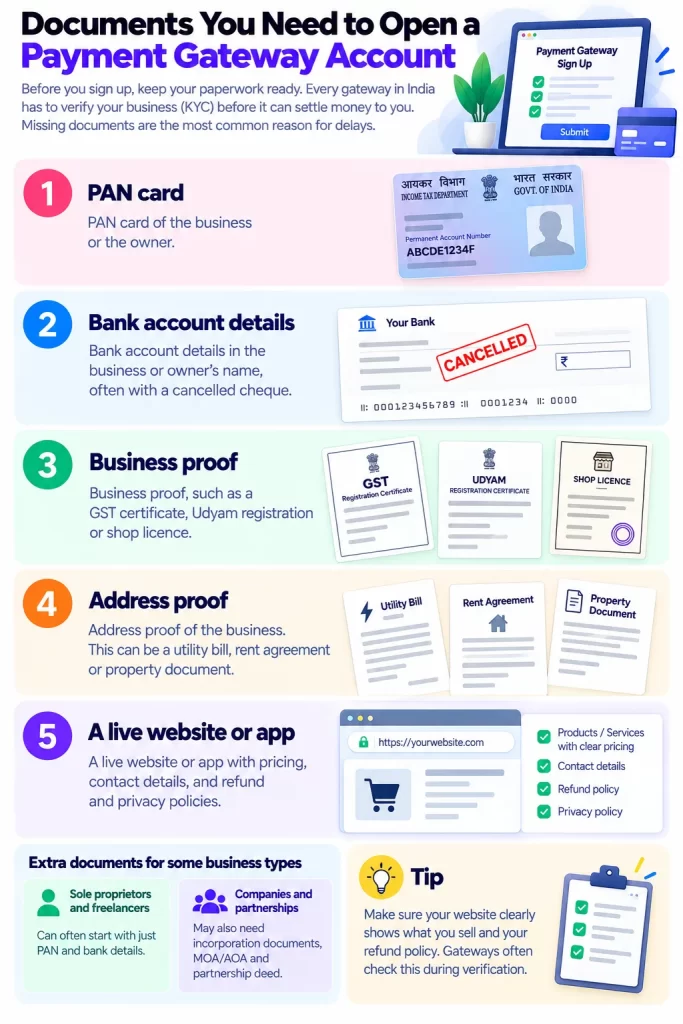
Before you sign up, keep your paperwork ready. Every gateway in India has to verify your business (KYC) before it can settle money to you. Missing documents are the most common reason for delays.
The exact list varies by gateway and business type, but you’ll usually need:
- PAN card of the business or the owner
- Bank account details in the business or owner’s name, often with a cancelled cheque
- Business proof, such as a GST certificate, Udyam registration or shop licence
- Address proof of the business
- A live website or app with pricing, contact details, and refund and privacy policies
Sole proprietors and freelancers can often start with just PAN and bank details. Companies and partnerships may also need incorporation documents.
Tip: Make sure your website clearly shows what you sell and your refund policy. Gateways often reject or delay applications when these pages are missing.
How to Choose the Best Payment Gateway in India for Your Business
So which one should you pick? There’s no single best payment gateway in India for everyone. The right choice depends on how you sell and who your customers are.
Ask yourself these questions:
1. How do your customers pay?
If most of your buyers use UPI, check how each gateway prices UPI. A gateway with lower UPI fees can save you a lot more than one with cheaper card rates.
On the other hand, if you sell high-value products on EMI, look for strong EMI and pay later options, like those from PayU or Razorpay.
2. Do you sell to international customers?
Foreign card fees vary, from about 3% to around 4.5% plus fixed fees on some platforms. If you sell abroad often, compare international rates closely. Freelancers can also add PayPal for overseas clients.
3. Which platform is your store on?
Make sure the gateway has a ready plugin for your platform, such as Shopify, WooCommerce or Wix. Not sure which platform to use? Our guide to the best ecommerce platforms in India can help. And if you’re selling on marketplaces instead, read how to sell on Meesho, since marketplaces handle payments for you.
4. How fast do you need your money?
Standard settlements usually take a few working days. If cash flow is tight, check the cost of instant settlements. It’s usually an extra fee per transaction.
5. What’s the total cost, not just the headline rate?
Look beyond the “2%” label. Add up:
- GST on the fee
- Fixed per-payment fees, if any
- Yearly charges after the first year
- Extra fees for instant settlement or payouts
A quick example: on 500 orders of ₹400 each, a ₹3 fixed fee adds ₹1,500 a month on top of the percentage fee. For small-ticket businesses, that matters.
6. Will it fit your accounting setup?
Finally, make sure your payment reports are easy to export. Clean data makes GST filing and bookkeeping much simpler. Our guides to the best GST billing software in India and the best accounting software in India for small business cover tools that connect well with popular gateways.
Quick picks by business type
- New startup or D2C brand: Razorpay or Cashfree
- Large ecommerce store: PayU or Razorpay
- UPI-heavy small business: PhonePe or Paytm
- Creator or freelancer selling in India: Instamojo or Razorpay payment links
- School or fee collection: Easebuzz
- Many payment options and currencies: CCAvenue
- Clients abroad: PayPal, alongside an Indian gateway
Final Thoughts: Pick the Gateway That Fits How You Sell
Choosing from the top 10 payment gateways in India doesn’t have to be confusing. Most charge around 2%, so the real difference lies in UPI pricing, international fees, offers and features.
Let’s recap:
- Razorpay and Cashfree are strong all-rounders for startups, with generous new-merchant offers.
- PayU and CCAvenue suit established stores that want many payment options.
- Paytm and PhonePe make sense when your customers mostly pay by UPI.
- Instamojo is the easiest start for creators and tiny sellers.
- Easebuzz works well for fee collection with custom pricing.
- PayPal and Stripe help with international payments, with some limits in India.
Most importantly, compare the total cost, not just the headline rate. A cheaper card fee won’t help if most of your customers pay by UPI.
Ready to start collecting payments? Shortlist two gateways from this list, sign up for the one with the best offer, and test a few real orders this week. Once payments are flowing, our list of the best marketing software for small business in India can help you bring in more buyers. And to save time on daily tasks, explore the best AI tools for small business in India.
Frequently Asked Questions
For most small businesses, Razorpay and Cashfree are strong choices thanks to easy setup, zero setup fees and new-merchant offers. If most of your customers pay by UPI, PhonePe and Paytm are also worth comparing.
Most payment gateways in India charge around 2% per successful transaction, plus 18% GST on the fee. International cards, Amex and Diners usually cost about 3% to 4.5%. Most big gateways charge no setup fee.
Bank-to-bank UPI payments carry zero MDR under government rules. However, some payment gateways still charge a platform fee on UPI. So check each gateway’s UPI pricing before you sign up.
PayPal in India supports only international payments, so it can’t collect money from Indian customers. Stripe moved to an invite-only model for new Indian businesses in 2024, so you may not be able to sign up without an invite.
Not always. Gateways like Razorpay and Instamojo offer payment links and simple payment pages. You can share these on WhatsApp, email or social media and collect payments without a full website.
Поздравляю, какие слова…, отличная мысль
обмен скинов, обмен скинов кс 2 – это увлекательный процесс, который привлекает множество игроков. Каждый пользователи стремятся освежить свои коллекции. Наблюдается множество платформ для совершения сделок, где принимается находить привлекательные предложения. Благодаря этому процессу друзья могут также обмениваться эффектами, но и создавать новые знакомства. Успех в этом деле во многом зависит на взаимопонимание между сторонами.