



Picture a small hardware shop in Indore. The owner still uses a printed bill book and a blue pen. A customer asks for a GST bill, and he writes one by hand, just like he has for years.
- Is a Handwritten GST Invoice Valid? The Short Answer
- When a Handwritten GST Invoice Is Not Valid: The E-Invoicing Rule
- GST Invoice Format: Mandatory Fields Under Rule 46
- Sample Handwritten GST Invoice Template
- Handwritten GST Invoice Rules You Shouldn’t Skip
- Common Mistakes on Handwritten GST Bills
- Handwritten vs Computer-Generated GST Invoice
- Final Thoughts: Your Pen Is Fine, But the Details Matter
- Frequently Asked Questions
But then a doubt creeps in. Is this handwritten bill even legal under GST?
It’s a fair question. Most of what you read about GST talks about software, portals and e-invoices. So it’s easy to assume that paper bills are out.


Here’s the good news. A handwritten GST invoice can be fully valid, as long as it follows the rules. However, there’s one big exception, and a few common mistakes can make your bill useless for your buyer’s tax credit.
In this guide, you’ll learn:
- Whether a handwritten GST invoice is valid, and what the law says
- When you can’t use a handwritten invoice
- The exact fields every GST bill format must include
- A simple sample layout you can copy into your bill book
- How many copies to make and when to issue them
- Common mistakes, and when it’s time to switch to billing software
Note: This article explains the rules in plain language. For your specific case, it’s always wise to check with your CA.


Is a Handwritten GST Invoice Valid? The Short Answer
Yes, for most small businesses. The GST law doesn’t say an invoice must be printed or typed. Instead, it says what an invoice must contain.
Think of it like a cheque. Nobody cares whether you wrote it with a fountain pen or a ballpoint. What matters is that the date, amount, name and signature are correct. A GST bill works the same way.


What the law actually says
Two rules under the CGST Rules, 2017 shape how invoices work:
- Rule 46 lists the details every tax invoice must show. You can read the full text on the CBIC’s official Rule 46 page.
- Rule 48 explains how many copies to make and when e-invoicing applies.
Neither rule bans handwritten bills. So if your manual GST invoice includes every required detail, it’s a valid tax invoice.
Why validity matters so much
You might think, “A bill is a bill. Why worry?” But for your customer, it’s a big deal.
A registered buyer can claim input tax credit (ITC) only if they hold a proper tax invoice. If your bill is missing your GSTIN or the tax split, their claim may be rejected. As a result, they may stop buying from you, or ask you to reissue the bill.
In other words, a valid invoice protects both you and your customer.
Who should not use a tax invoice at all
One quick point before we go further. Not every GST-registered business issues a tax invoice.
If you’re under the composition scheme, you issue a bill of supply instead. You can’t charge GST separately on it, and your buyer can’t claim ITC. The same applies when you sell only exempt goods or services. So if that’s you, this guide’s format rules still help, but your document has a different name and fewer tax fields.
When a Handwritten GST Invoice Is Not Valid: The E-Invoicing Rule
Now for the big exception. If your business must follow e-invoicing, a handwritten bill won’t work for business-to-business (B2B) sales.
Who must issue e-invoices?
E-invoicing applies to businesses whose aggregate turnover has crossed ₹5 crore in any financial year since 2017-18. This threshold was set by CBIC Notification No. 10/2023 and took effect on 1 August 2023.
For these businesses, every B2B invoice must be reported on the government’s Invoice Registration Portal first. The portal then returns an Invoice Reference Number (IRN) and a QR code, which must appear on the invoice.
Why paper fails here
Rule 48(5) is very direct. If a business that must e-invoice issues an invoice any other way, it “shall not be treated as an invoice.”
So imagine a ₹6 crore distributor hands a buyer a neatly written bill. It might look perfect. Still, in the eyes of the law, it’s not an invoice at all, and the buyer can’t use it to claim ITC.
What if you’re above ₹5 crore but exempt?
Some sectors, such as banks, insurance companies and SEZ units, are exempt from e-invoicing. If you fall in such a class, Rule 46 asks you to add a declaration on your invoice saying you’re not required to issue an e-invoice.
Quick check: can you use handwritten bills?
| Your situation | Handwritten tax invoice OK? |
|---|---|
| Turnover up to ₹5 crore, B2B or B2C sales | Yes, if all Rule 46 details are present |
| Turnover above ₹5 crore, B2C sales to consumers | Generally yes, with all required details (above ₹500 crore, B2C bills also need a dynamic QR code) |
| Turnover above ₹5 crore, B2B sales | No, an e-invoice with IRN is required |
| Composition scheme | Issue a bill of supply instead |
In short, small and mid-sized businesses can keep their bill books. But once you cross ₹5 crore, B2B billing has to move online.
GST Invoice Format: Mandatory Fields Under Rule 46
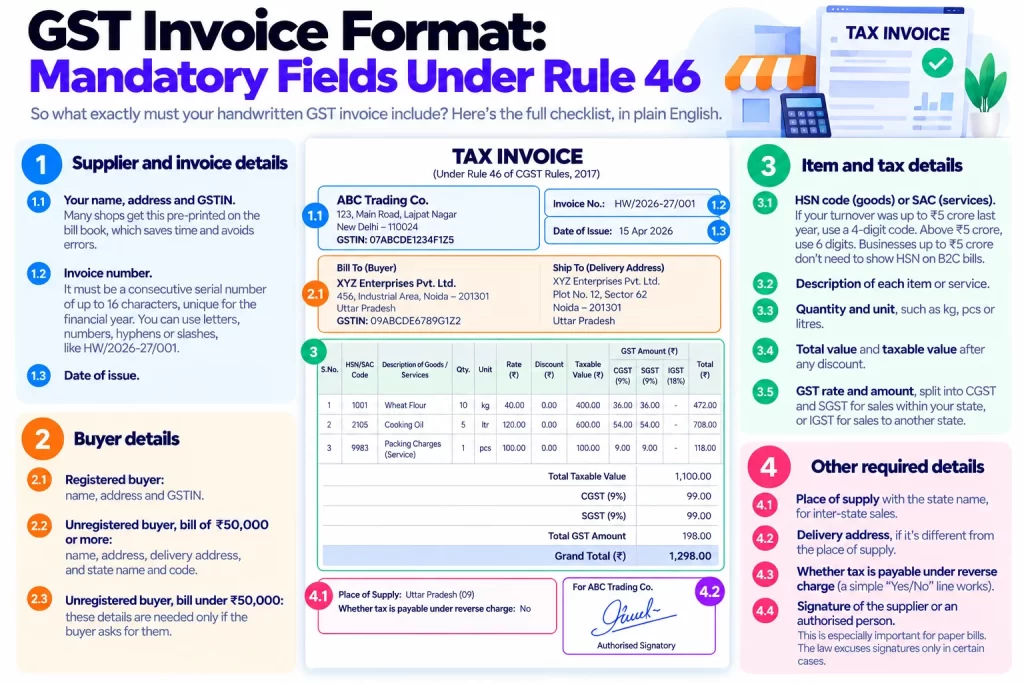
So what exactly must your handwritten GST invoice include? Here’s the full checklist, in plain English.
Supplier and invoice details
- Your name, address and GSTIN. Many shops get this pre-printed on the bill book, which saves time and avoids errors.
- Invoice number. It must be a consecutive serial number of up to 16 characters, unique for the financial year. You can use letters, numbers, hyphens or slashes, like HW/2026-27/001.
- Date of issue.
Buyer details
- Registered buyer: name, address and GSTIN.
- Unregistered buyer, bill of ₹50,000 or more: name, address, delivery address, and state name and code.
- Unregistered buyer, bill under ₹50,000: these details are needed only if the buyer asks for them.
Item and tax details
- HSN code (goods) or SAC (services). If your turnover was up to ₹5 crore last year, use a 4-digit code. Above ₹5 crore, use 6 digits. Businesses up to ₹5 crore don’t need to show HSN on B2C bills.
- Description of each item or service.
- Quantity and unit, such as kg, pcs or litres.
- Total value and taxable value after any discount.
- GST rate and amount, split into CGST and SGST for sales within your state, or IGST for sales to another state.
Other required details
- Place of supply with the state name, for inter-state sales.
- Delivery address, if it’s different from the place of supply.
- Whether tax is payable under reverse charge (a simple “Yes/No” line works).
- Signature of the supplier or an authorised person.
That last one matters more for paper bills. The law excuses signatures only for electronic invoices issued under the IT Act. So on a handwritten bill, always sign.
Sample Handwritten GST Invoice Template
Need a simple layout to copy into your bill book? Here’s a sample tax invoice structure that covers every required field.
Top section (header):
- TAX INVOICE (written clearly at the top)
- Your business name, address and GSTIN
- Invoice No.: HW/2026-27/045 | Date: 23-10-2026
- Place of supply: Madhya Pradesh (23)
- Reverse charge: No
Buyer section:
- Bill to: buyer’s name, address and GSTIN
- Ship to: delivery address (if different)
Item table:
| S.No. | Description | HSN | Qty | Rate (₹) | Taxable value (₹) | CGST 9% (₹) | SGST 9% (₹) | Total (₹) |
|---|---|---|---|---|---|---|---|---|
| 1 | PVC pipe, 1 inch | 3917 | 20 pcs | 150 | 3,000 | 270 | 270 | 3,540 |
| 2 | PVC elbow, 1 inch | 3917 | 40 pcs | 40 | 1,600 | 144 | 144 | 1,888 |
| Total | 4,600 | 414 | 414 | 5,428 |
Bottom section:
- Total in words: Rupees Five Thousand Four Hundred Twenty-Eight Only
- Signature and stamp of the supplier
- Copy marking: Original for Recipient
Tip: HSN codes and rates above are only examples. Always check the correct code and GST rate for your own products.
Handwritten GST Invoice Rules You Shouldn’t Skip
Getting the fields right is half the job. The other half is following a few process rules that many small businesses overlook.
How many copies do you need?
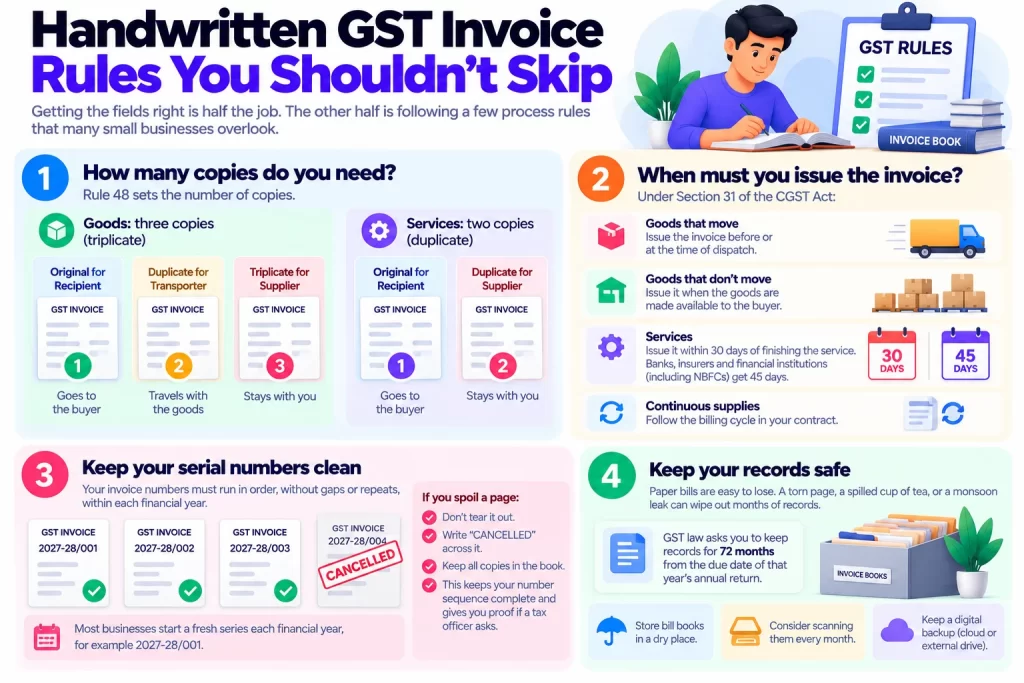
Rule 48 sets the number of copies:
- Goods: three copies (triplicate): Original for Recipient goes to the buyer, Duplicate for Transporter travels with the goods, and Triplicate for Supplier stays with you.
- Services: two copies (duplicate): Original for Recipient goes to the buyer, and Duplicate for Supplier stays with you.
This is where carbon-copy bill books come in handy. Just write each copy’s label at the top. If you’ve ever searched for a transport bill format, this “Duplicate for Transporter” copy is the one your driver should carry.
When must you issue the invoice?
Timing matters too. Under Section 31 of the CGST Act:
- Goods that move: issue the invoice before or at the time of dispatch.
- Goods that don’t move: issue it when the goods are made available to the buyer.
- Services: issue it within 30 days of finishing the service. Banks, insurers and financial institutions (including NBFCs) get 45 days.
- Continuous supplies: follow the billing cycle in your contract.
Keep your serial numbers clean
Your invoice numbers must run in order, without gaps or repeats, within each financial year. So what happens if you spoil a page?
Don’t tear it out. Instead, write “CANCELLED” across it and keep all copies in the book. That way, your number sequence stays complete, and you have proof if a tax officer asks.
Also, most businesses start a fresh series each financial year, for example 2027-28/001.
Keep your records safe
Paper bills are easy to lose. A torn page, a spilled cup of tea, or a monsoon leak can wipe out months of records. Since GST law asks you to keep records for 72 months from the due date of that year’s annual return, store bill books in a dry place and consider scanning them every month.
Common Mistakes on Handwritten GST Bills
Even careful shopkeepers slip up. Here are the errors that cause the most trouble:
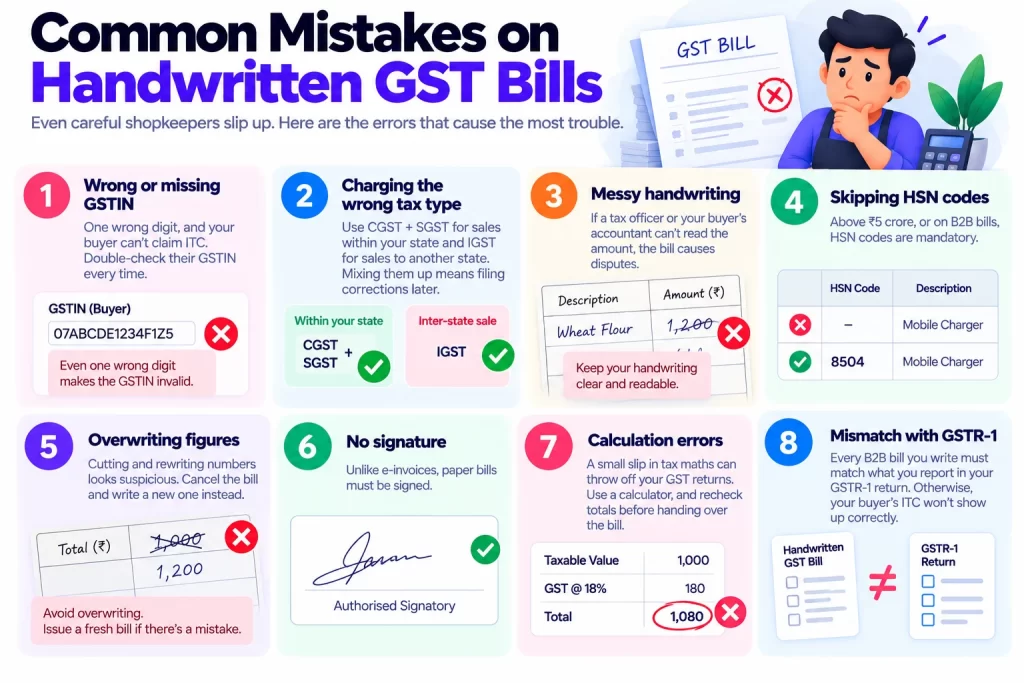
- Wrong or missing GSTIN. One wrong digit, and your buyer can’t claim ITC. Double-check their GSTIN every time.
- Charging the wrong tax type. Use CGST + SGST for sales within your state and IGST for sales to another state. Mixing them up means filing corrections later.
- Messy handwriting. If a tax officer or your buyer’s accountant can’t read the amount, the bill causes disputes.
- Skipping HSN codes. Above ₹5 crore, or on B2B bills, HSN codes are mandatory.
- Overwriting figures. Cutting and rewriting numbers looks suspicious. Cancel the bill and write a new one instead.
- No signature. Unlike e-invoices, paper bills must be signed.
- Calculation errors. A small slip in tax maths can throw off your GST returns. Use a calculator, and recheck totals before handing over the bill.
- Mismatch with GSTR-1. Every B2B bill you write must match what you report in your GSTR-1 return. Otherwise, your buyer’s ITC won’t show up correctly.
How to fix a mistake after the bill is issued
What if you spot an error only after the buyer has left with the bill? Don’t panic, and don’t rewrite the old invoice with a new date.
Instead, GST law gives you two simple tools:
- Credit note: use it when you charged too much, for example a higher rate or extra quantity, or when goods are returned.
- Debit note: use it when you charged too little and need to add the difference.
Both notes should mention the original invoice number and date, and you can write them by hand too. Just remember to report them in your GST returns, so your books and your buyer’s records stay in sync.
What about a wrong GSTIN? If the buyer is the same and only a digit is wrong, you can usually correct it by amending the invoice in a later GSTR-1. However, if the bill went to the wrong business altogether, you’ll need to issue a fresh invoice to the right buyer. Your CA can guide you on the right approach for your case.
Handwritten vs Computer-Generated GST Invoice
So should you stick with your bill book or switch to software? Let’s compare them side by side.
| Factor | Handwritten invoice | Billing software |
|---|---|---|
| Legally valid? | Yes, if all fields are present (below e-invoice limit) | Yes, and required for B2B e-invoicing above ₹5 crore |
| Upfront cost | Just a bill book | Free plans exist; paid plans cost more |
| Speed | Slow for many items | Fast, with saved products and customers |
| Tax calculation | Manual, so errors are possible | Automatic CGST, SGST and IGST split |
| GST return filing | Retype every bill into GSTR-1 | Exports or files data directly |
| Record safety | Paper can be lost or damaged | Backed up in the cloud or on your system |
| Works without power or internet | Yes | Depends on the tool; some work offline |
When does a bill book still make sense?
A handwritten GST invoice works fine if:
- You raise only a few bills a day
- Most of your sales are simple and within one state
- You have a CA or accountant who enters bills into returns for you
- You need a backup during power cuts or internet outages
Signs it’s time to switch
On the other hand, consider moving to software when:
- You’re spending hours each month copying bills into returns
- Buyers often complain about errors in their ITC
- Your turnover is getting close to ₹5 crore
- You sell online, where marketplaces need quick, clean invoicing
The good news? Switching doesn’t have to be expensive. Many tools offer free plans for small businesses. Our guide to the best GST billing software in India compares free and paid options. If you also want full bookkeeping, see our list of the best accounting software in India for small business, which includes popular tools like TallyPrime and Zoho Books.
Selling on marketplaces? Clean invoices make settlements and returns easier. Our guides on how to sell on Meesho and the best ecommerce platforms in India explain what online sellers need to get started.
A practical middle path
You don’t have to choose just one. Many shops use billing software as their main system and keep a pre-printed bill book as a backup. When the power goes out, they write bills by hand and enter them into the software later. Just make sure both use the same numbering series, so there are no gaps or duplicates.
Final Thoughts: Your Pen Is Fine, But the Details Matter
So, is a handwritten GST invoice valid? For most small businesses, yes. The law cares about what’s on the bill, not whether it was written by hand or printed.
Let’s recap the key points:
- A handwritten GST invoice is valid if it includes every detail listed in Rule 46.
- E-invoicing is the big exception. Once your turnover crosses ₹5 crore, B2B bills must carry an IRN and QR code, so paper bills won’t count.
- Follow the right GST bill format: your GSTIN, serial number, buyer details, HSN, tax split, place of supply and signature.
- Make the right number of copies: three for goods, two for services.
- Issue bills on time and never tear out spoiled pages.
As your business grows, billing software can save hours and cut down on errors. Similarly, once you hire staff, tools from our list of the best payroll software in India can handle salaries and compliance. And if you want to automate more of your admin, check out the best AI tools for small business in India.
Ready to make sure your bills are right? Grab your bill book, compare one recent invoice with the checklist above, and fix any missing details today.
Frequently Asked Questions
Yes. A registered buyer can claim ITC on a handwritten GST invoice if it contains all the details required under Rule 46 and the supplier reports it in their GSTR-1. However, if the supplier must issue e-invoices, a handwritten B2B bill isn’t valid for ITC.
A basic GST bill format includes your name, address and GSTIN, an invoice number, the date, buyer details, HSN code, item description, quantity, taxable value, GST rate and amount, place of supply and your signature. The sample tax invoice layout above covers all of these.
Yes. In fact, a pre-printed bill book with your business name, GSTIN and serial numbers reduces mistakes. Just make sure it has columns for HSN, taxable value and the CGST, SGST or IGST split.
Yes. Rule 46 requires the signature or digital signature of the supplier or an authorised person. The exception is only for electronic invoices issued under the IT Act, so every handwritten bill should be signed.
Yes. You can copy the sample handwritten GST invoice template in this article into your bill book. Alternatively, most billing apps include free GST invoice templates that fill in tax amounts automatically.
нормуль
Exploring the realm of GAYSEX, GAYSEX can lead to thrilling experiences. Many look for new methods to connect with passion. It’s important to share openly about likings and establish confidence among partners.