



Running a small business in India means wearing a lot of hats. You sell, you hire, you chase payments. And then GST filing day shows up and eats your whole weekend.
- Top 10 Accounting Software in India at a Glance
- What to Look for in Accounting Software for Small Business
- 10 Best Accounting Software in India for Small Business (2026)
- How to Choose the Right Accounting Software for Your Business
- Final Thoughts: Pick the Tool That Fits, Not the Most Popular One
- Frequently Asked Questions
Sound familiar?
The right accounting tool won’t do your job for you. But it can turn hours of spreadsheet work into a few clicks. The problem is choosing one. There are dozens of options, and most of them claim to be “the best.”

So we did the sorting for you. This guide covers the 10 best accounting software in India for small business in 2026. You’ll see what each tool does well, where it falls short, and what it really costs.
Here’s what we’ll cover:
- A quick comparison table of all 10 tools
- The features that matter for Indian small businesses
- A closer look at each software, with pricing and pros and cons
- How to pick between free and paid, and cloud and desktop
- Answers to common questions
Let’s get into it.


Top 10 Accounting Software in India at a Glance
Short on time? This table gives you the big picture. Prices are starting prices before 18% GST, and they can change, so always check the vendor’s site before you buy.
| Software | Best for | Type | Starting price (excl. GST) | Free option |
|---|---|---|---|---|
| Zoho Books | Most small businesses | Cloud | ₹749/month (billed yearly) | Yes, under ₹25 lakh revenue |
| TallyPrime | CA-friendly desktop accounting | Desktop | ₹750/month or ₹22,500 one-time (Silver) | No |
| BUSY | Traders with heavy inventory | Desktop | ₹11,000 one-time (Basic) | No, trial only |
| Vyapar | Shops and micro businesses | Mobile + desktop | About ₹3,399/year (desktop) | Yes, mobile app |
| myBillBook | Fast GST billing | Mobile + web | About ₹142/month (billed yearly) | Trial only |
| Swipe | Invoicing with UPI collections | Mobile + web | ₹2,999/user/year | Yes |
| Marg ERP 9+ | Distributors, pharma, FMCG | Desktop | About ₹8,100 one-time (Basic) | Demo only |
| Giddh | Tight budgets | Cloud | About ₹400/year | Trial |
| Refrens | Freelancers and agencies | Cloud | Paid plans from about $130/year | Yes, basic plan |
| Odoo | Growing teams that need an ERP | Cloud | ₹580/user/month (billed yearly) | Yes, one app free |
What to Look for in Accounting Software for Small Business
Before we get to the list, let’s talk about what makes a tool worth paying for. A shiny dashboard means nothing if it can’t file your GST return.
Highly Related

Here are the features we checked for each software.
1. GST compliance built in
This one is non-negotiable in India. Your software should create GST invoices, track input tax credit, and prepare GSTR-1 and GSTR-3B data.
Also check for e-invoicing and e-way bill support. Businesses with aggregate turnover above ₹5 crore must generate e-invoices, as per CBIC Notification No. 10/2023. Even if you’re below that today, you may cross it sooner than you think.
2. Ease of use
Will you be doing the entries yourself? Then pick something simple. A tool your team avoids is worse than no tool at all.
Ask for a demo or start a free trial. If you can’t raise an invoice in the first 10 minutes, that’s a red flag.
3. Inventory management
Traders, retailers and distributors need stock tracking. Look for batch numbers, expiry dates, multiple godowns and low-stock alerts.
Service businesses can skip this. Pay only for what you use.
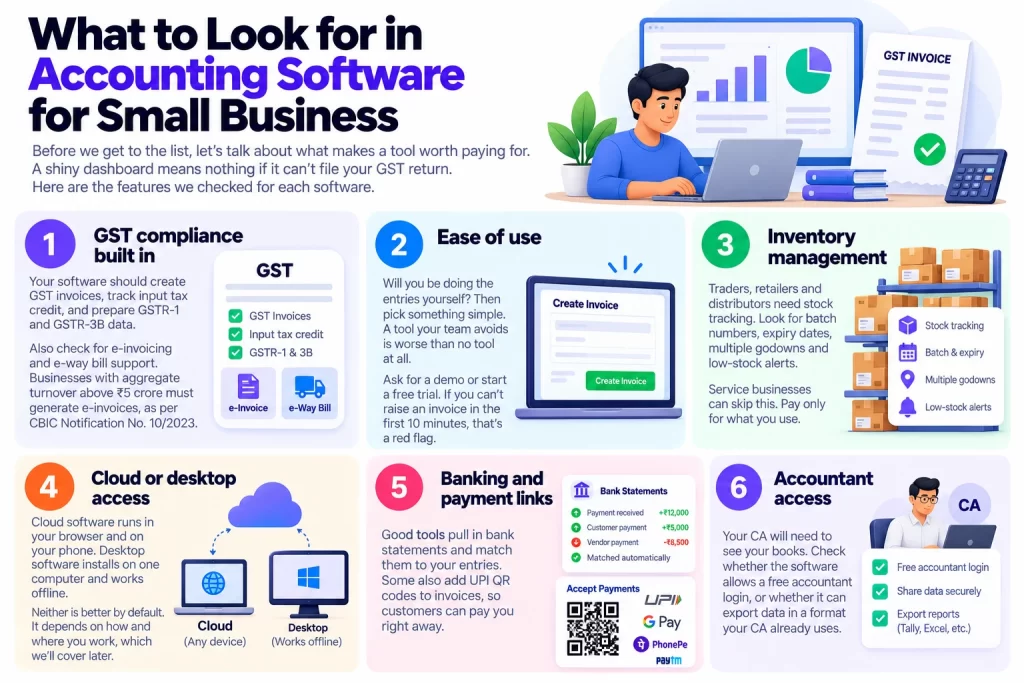
4. Cloud or desktop access
Cloud software runs in your browser and on your phone. Desktop software installs on one computer and works offline.
Neither is better by default. It depends on how and where you work, which we’ll cover later.
5. Banking and payment links
Good tools pull in bank statements and match them to your entries. Some also add UPI QR codes to invoices, so customers can pay you right away.
6. Accountant access
Your CA will need to see your books. Check whether the software allows a free accountant login, or whether it can export data in a format your CA already uses.
10 Best Accounting Software in India for Small Business (2026)
Now for the main event. Each tool below is listed with who it suits, what it costs, and where it struggles.
1. Zoho Books: Best Overall for Small Businesses
If you want one safe pick, this is it. Zoho Books is cloud-based, built for Indian GST, and simple enough for non-accountants.
You can raise invoices, file GST returns, generate e-invoices and e-way bills, and reconcile your bank, all in one place. It also connects with other Zoho apps. So if you later add Zoho Payroll or a CRM, your data flows across without extra work. (Comparing payroll tools too? See our guide to the best payroll software in India.)
Pricing: Free for businesses under ₹25 lakh annual revenue. Paid plans start at ₹749 per month, billed yearly, and go up to ₹8,332 per month for the top tier.
Pros:
- Clean, easy interface on web and mobile
- Strong GST, e-invoicing and bank feed support
- Free plan is good for very small businesses
Cons:
- The free plan allows only 1 user and 1,000 invoices a year
- Advanced inventory needs a higher plan or Zoho Inventory
2. TallyPrime: Best Desktop Software for Traditional Accounting
Ask ten Indian CAs which software they know best. Most will say Tally.
TallyPrime is the current version of that familiar tool. It works offline, handles GST and inventory well, and produces every report your CA could want. If your accountant already works in Tally, sharing data becomes much easier.
Pricing: You can rent a single-user licence for ₹750 per month, or buy it for ₹22,500 one-time (Silver). The multi-user Gold licence costs ₹67,500. Yearly renewal for updates starts at ₹4,500 for Silver, as per Tally’s official pricing page.
Pros:
- Trusted by accountants across India
- Works without internet
- Deep GST, inventory and payroll features
Cons:
- Takes time to learn if you’re new to accounting
- Remote access usually needs an extra cloud setup or hosting service
3. BUSY: Best for Inventory-Heavy Traders
BUSY is a desktop accounting software that shines when you deal with lots of stock. Think wholesalers, retailers and small manufacturers.
It handles batch and expiry tracking, multiple godowns, and detailed GST reports. Many users find it a little easier on the eyes than Tally, while offering similar depth.
Pricing: One-time licences cost ₹11,000 (Basic), ₹16,500 (Standard) and ₹22,000 (Enterprise) for a single user. Yearly renewal runs ₹4,000 to ₹7,500. There’s also a subscription range called BUSY Magic, starting at ₹5,000 a year.
Pros:
- Strong inventory and manufacturing features
- One-time licence option
- Good GST and e-invoicing support
Cons:
- Desktop-first, so mobile access is limited
- If your renewal lapses, updates and connected GST features stop
4. Vyapar: Best for Shops and Micro Businesses
Run a kirana store, a pharmacy counter or a small showroom? Vyapar was made for you.
It’s a billing-first app that also keeps your books. You can create GST bills, track stock, record payments and send reminders on WhatsApp. It works offline too, which helps when your internet drops mid-sale.
Pricing: The mobile app has a free version for one device. Paid desktop plans start at around ₹3,399 a year, with multi-year bundles cutting the yearly cost.
Pros:
- Very easy to learn
- Free mobile version for single-device use
- Works offline
Cons:
- Free version lacks desktop billing, barcode support and device sync
- Not built for complex accounting or large teams
5. myBillBook: Best for Quick GST Billing
myBillBook is all about speed. Open the app, add items, and send a GST invoice in under a minute.
It also covers stock, expenses, and basic reports like profit and loss. Want more billing-focused picks? Our list of the best GST billing software in India compares the top options side by side.
Pricing: Paid plans have been listed from about ₹142 per month, billed yearly. Check the current price on its website, since rates change often. A free trial is available.
Pros:
- Fast, simple invoicing on mobile and web
- Handy for small retail and service businesses
- Affordable paid plans
Cons:
- No permanent free plan
- Accounting depth is basic compared to Zoho Books or Tally
6. Swipe: Best for Invoicing With UPI Collections
Getting paid on time is half the battle for small businesses. Swipe tackles that head-on.
Every invoice can carry a UPI QR code, and you can share bills on WhatsApp in seconds. It also handles e-way bills, one-click e-invoicing, GSTR-1 reports and multi-warehouse stock. Selling online? Swipe connects with Shopify and Shiprocket, which pairs well with the platforms in our best ecommerce platforms in India guide.
Pricing: There’s a free version. Paid plans run from ₹2,999 to ₹7,499 per user per year, depending on features like e-invoicing.
Pros:
- UPI QR codes and payment reminders help you collect faster
- Integrates with TallyPrime, Shopify and Razorpay
- Good for both retail and online sellers
Cons:
- Priced per user, so costs rise as your team grows
- More of a billing tool than full accounting software
7. Marg ERP 9+: Best for Distributors and Pharma
Marg has been around for decades, and it has a loyal following among chemists, FMCG distributors and wholesalers.
It’s a desktop ERP that combines accounting with deep inventory control. Expiry tracking, schemes, discounts, and salesman-wise reports are all built in. For a medical store or a distribution business, these features save a lot of manual effort.
Pricing: Licences are sold through dealers. Expect roughly ₹8,100 for Basic, ₹12,600 for Silver and ₹25,200 for Gold, plus a yearly maintenance fee. Dealer prices can vary.
Pros:
- Industry-specific features for pharma and FMCG
- One-time licence model
- Strong inventory and batch tracking
Cons:
- Interface feels dated
- Pricing isn’t transparent, since dealers set their own rates
8. Giddh: Best Budget Cloud Option
What if you want cloud accounting but don’t want to pay Zoho prices? Giddh is worth a look.
It covers GST returns, invoicing, bank reconciliation, inventory and multi-currency. It also allows unlimited users and can sync with Tally, which makes the switch less painful.
Pricing: Plans start at around ₹400 per organisation per year, with a cap of 10,000 transactions a year on that tier. A free trial is available.
Pros:
- Very affordable
- Unlimited users
- Tally sync and Shopify integration
Cons:
- Smaller brand, so fewer tutorials and CAs who know it
- Transaction limits on lower plans
9. Refrens: Best for Freelancers and Agencies
Refrens started as an invoicing tool for freelancers. Today, it covers quotes, expenses, receivables, payables and GST compliance.
It’s a good fit for service businesses like design studios, consultants and digital agencies. It also uses AI to scan vendor bills and receipts, which cuts down on data entry. If you like tools that do the boring work for you, see our list of the best AI tools for small business in India.
Pricing: A basic free plan is available. Paid accounting plans start at about $130 a year.
Pros:
- Polished invoices and quotes
- Payment links through Razorpay and Cashfree
- AI-powered bill scanning
Cons:
- Limited inventory features
- Pricing is often shown in US dollars
10. Odoo: Best for Growing Businesses That Need an ERP
Planning to scale fast? Odoo is more than accounting software. It’s a full business suite with apps for sales, inventory, HR, manufacturing and more.
You can start with just the accounting or invoicing app and add others as you grow. That modular setup is its biggest strength.
Pricing: Odoo offers one app free. The Standard plan costs about ₹580 per user per month, billed yearly. There’s also a free Community edition you can host yourself.
Pros:
- Grows with you, from invoicing to full ERP
- Huge app library
- Open-source Community version available
Cons:
- Setup can be complex without a partner
- Per-user pricing adds up for bigger teams
How to Choose the Right Accounting Software for Your Business
Ten options is still a lot. So let’s narrow it down with three simple questions.
Free vs paid: is free accounting software enough?
For many new businesses, yes. Zoho Books, Vyapar, Swipe and Refrens all offer free plans that cover basic invoicing and GST billing.
However, free plans come with limits. You might get only one user, a cap on invoices, or no bank feeds. Think of a free plan like a learner’s licence. It’s great for getting started, but you’ll want the full licence once you’re on the highway.
A good rule: start free, then upgrade when the limits start costing you time.
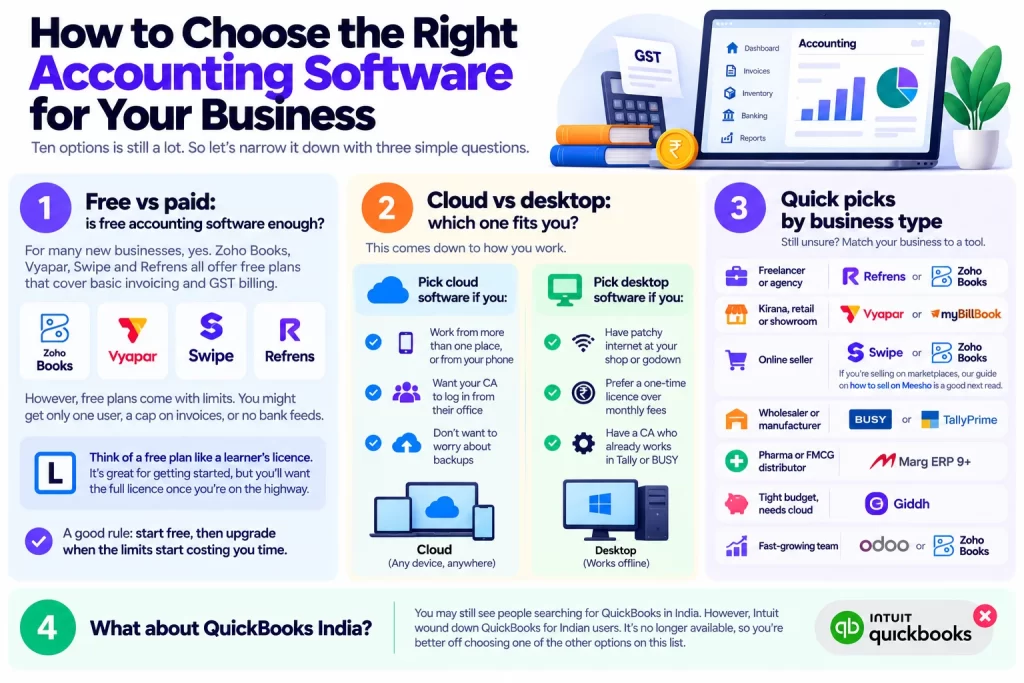
Cloud vs desktop: which one fits you?
This comes down to how you work.
Pick cloud software if you:
- Work from more than one place, or from your phone
- Want your CA to log in from their office
- Don’t want to worry about backups
Pick desktop software if you:
- Have patchy internet at your shop or godown
- Prefer a one-time licence over monthly fees
- Have a CA who already works in Tally or BUSY
Quick picks by business type
Still unsure? Match your business to a tool:
- Freelancer or agency: Refrens or Zoho Books
- Kirana, retail or showroom: Vyapar or myBillBook
- Online seller: Swipe or Zoho Books. If you’re selling on marketplaces, our guide on how to sell on Meesho is a good next read.
- Wholesaler or manufacturer: BUSY or TallyPrime
- Pharma or FMCG distributor: Marg ERP 9+
- Tight budget, needs cloud: Giddh
- Fast-growing team: Odoo or Zoho Books
What about QuickBooks India?
You may still see people searching for QuickBooks in India. However, Intuit wound down QuickBooks Online for Indian customers back in 2023. If you’re on an old setup, Zoho Books is the closest like-for-like move.
Final Thoughts: Pick the Tool That Fits, Not the Most Popular One
There’s no single best accounting software in India for every business. The right choice depends on your size, your industry and how you like to work.
Here’s the short version:
- Zoho Books is the best all-rounder for most small businesses.
- TallyPrime and BUSY suit owners who want powerful desktop software and a CA-friendly setup.
- Vyapar, myBillBook and Swipe are great for quick GST billing.
- Marg ERP 9+ fits pharma and distribution businesses.
- Giddh, Refrens and Odoo fill the budget, freelancer and growth gaps.
Whatever you pick, don’t overthink it. Most of these tools offer a free plan or trial. So shortlist two, test them with a week of real invoices, and keep the one that feels easiest.
Once your books are sorted, put that saved time into growth. Our guides to the best marketing software for small business in India and the best SEO tools for small businesses can help you bring in more customers.
Ready to stop losing weekends to GST? Pick one tool from this list and start your free trial today.
Frequently Asked Questions
For most small businesses, Zoho Books is the best all-round choice. It’s cloud-based, GST-ready and has a free plan for businesses under ₹25 lakh revenue. If you prefer desktop software, TallyPrime is the most trusted option among Indian accountants.
Yes. Zoho Books, Vyapar (mobile), Swipe and Refrens all have free plans. Odoo also offers one app free. These work well for basic GST invoicing, though they limit users, invoices or advanced features.
TallyPrime Silver (single user) costs ₹22,500 as a one-time purchase or ₹750 per month on rent. TallyPrime Gold (multi-user) costs ₹67,500. Prices exclude 18% GST, and yearly renewal for updates starts at ₹4,500.
Reputable cloud tools use encryption, secure data centres and automatic backups. In many cases, that’s safer than a single office PC that could crash or get stolen. Just use strong passwords and turn on two-factor login where available.
Yes. Many cloud tools, including Giddh and Zoho Books, offer ways to bring over Tally data. Plan the move at the start of a financial year so your opening balances stay clean, and ask your CA to check the numbers after migration.